The problem
Running apartments în regim hotelier in Romania used to be a spreadsheet-and-grit business. By 2026 it had become a compliance minefield with a stopwatch on top. Our client managed roughly 90 apartments on behalf of owners across three very different markets — Bucharest city-breaks and corporate stays, Brașov mountain weekends, and Mamaia's brutal July–August seaside spike — listed on Airbnb, Booking.com, and a handful of direct channels. Nine people ran the whole thing, and most of their day went into typing the same answers to guests and chasing cleaners between checkouts.
The first clock was the guest. A traveler who messages at 23:40 asking how to get into the apartment expects an answer before they fall asleep in the taxi, and the platforms now bake response time and response rate straight into search ranking. The team answered fast during office hours and badly after — and every slow reply was a booking that quietly went to the listing next door.
The second was the turnover. With 90 apartments and a Saturday checkout-then-checkin rhythm, a single late cleaner or a missed 'guest left early, flip it now' message meant a 16:00 arrival walking into yesterday's towels. Cleaning was coordinated over three WhatsApp groups and a wall calendar, and in peak season something broke almost every weekend.
The third was money simply left on the table. Prices were set once a month and rarely touched. When a concert sold out in Bucharest or a long weekend hit Brașov, the apartments stayed at base rate while the hotels tripled theirs; when demand sagged midweek, empty nights went unsold instead of discounted. Nobody had time to reprice 90 listings by hand every day.
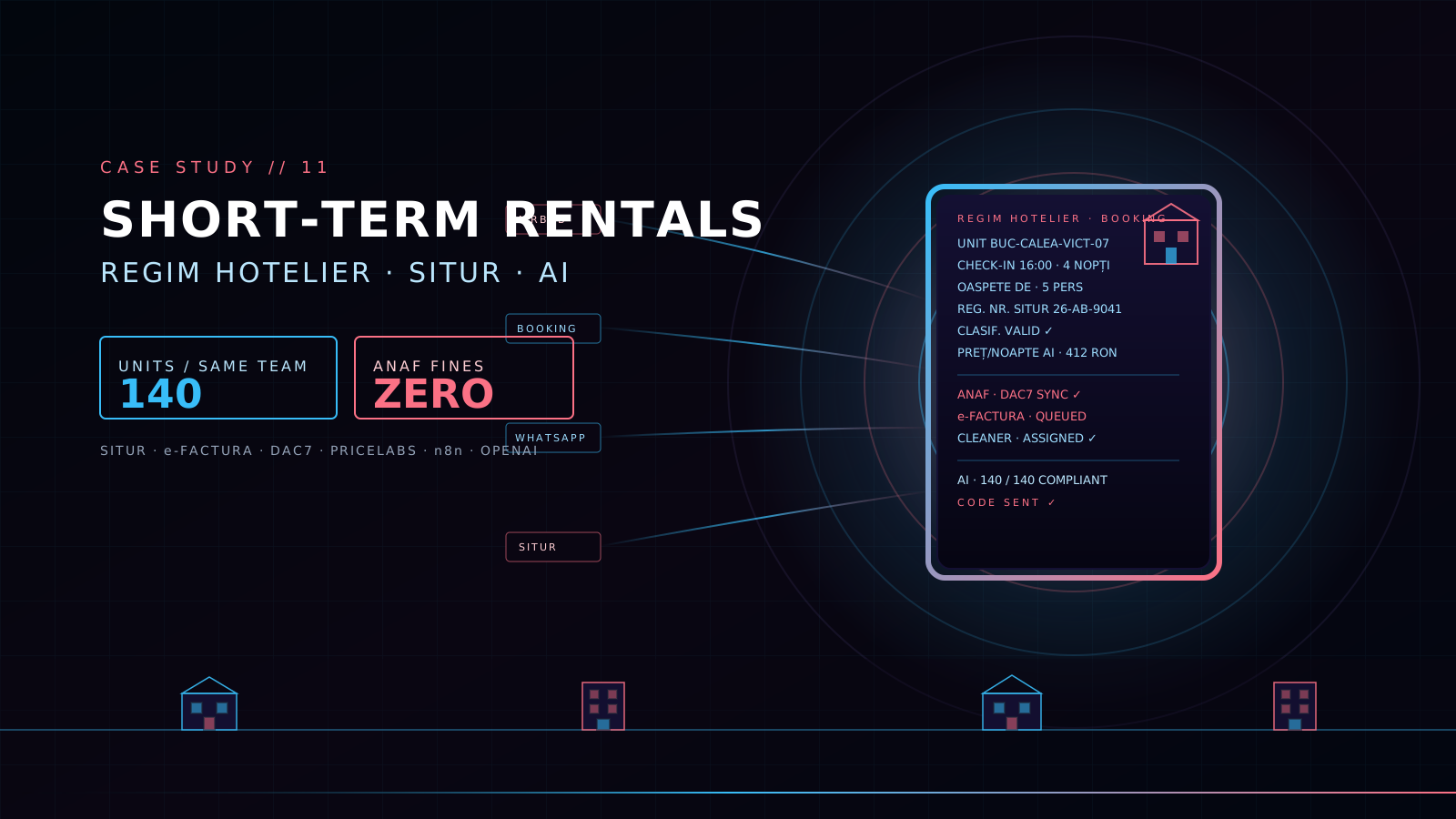
Then 2026 turned the background pressure into an existential one. On 20 May, the EU's Regulation 2024/1028 on short-term-rental data went live: platforms must now collect, verify, and display a registration number for every listing, and share host data with the authorities. In Romania that number ties back to the certificat de clasificare and the SITUR tourism registry — and the simplified 'up to 7 rooms / 14 beds, gross minus a flat 30%' tax regime only holds if the paperwork is clean. ANAF, armed with DAC7 platform data, put some 23,000 hosts under review and set fines of 10,000 to 40,000 lei for renting without authorization. On top of it, from 1 June 2026 e-Factura reaches individuals earning rental income through their CNP. Half the portfolio was one audit away from being delisted or fined — and the owners, who trusted the manager precisely so they'd never have to think about any of this, were starting to ask nervous questions.
What we built
We didn't replace the PMS or the channel manager the operator already used — we wrapped an AI agent around them that handles the conversation, the turnover, the pricing signal, and the compliance paper trail, and escalates to a human the moment money, a complaint, or a legal decision is on the line. Everything writes back into the existing system, so the team kept one screen, not six.
The principle we set with the founder on day one: the agent can answer, schedule, quote, and prepare filings, but a human owns every refund, every damage claim, every price floor, and every signature ANAF will see. The bot earns the routine; the people keep the judgment.
- 24/7 guest concierge in 5 languages (RO/EN/DE/FR/IT) across Airbnb, Booking, and WhatsApp: answers check-in questions, sends door codes at the right hour, handles the 'where do I park / how does the AC work' flood, and routes anything about money or a complaint to a human in seconds — over 70% of messages now resolve without staff touching them, with a median reply under 90 seconds
- Registration-number guardian: keeps each apartment's certificat de clasificare / SITUR registration number mapped to the right listing on every platform, flags a number that's missing, expired, or mismatched before the platform suspends the listing, and blocks a new unit from going live until its paperwork is in — so the portfolio stayed 100% compliant the week Regulation 2024/1028 took effect
- Demand-based pricing co-pilot: pulls local events, competitor rates, and booking pace, then proposes a nightly price per unit within owner-approved floors and ceilings — the revenue manager approves or overrides in one tap instead of editing 140 calendars by hand
- Turnover orchestrator: the instant a checkout is confirmed (or a guest messages that they're leaving early), it assigns the right cleaner, sends the address and access, confirms the flip with a photo, and won't release the next check-in code until the unit is marked ready — late-arrival-into-a-dirty-flat incidents went from routine to near zero
- Review engine: nudges happy guests toward a 5-star review at the right moment, drafts a calm on-brand reply to a critical one for a human to approve, and surfaces a recurring complaint (a noisy boiler, a tired mattress) to the owner before it tanks the listing
- ANAF & e-Factura prep: reconciles platform payouts against bookings, tags each owner's income for the flat-30% regime, prepares the e-Factura issuance that becomes mandatory on 1 June 2026, and assembles a clean Declarația Unică pack per owner — so tax season is a review, not an archaeology dig
- Owner portal: each owner sees their own units' occupancy, revenue, upcoming payouts, and compliance status in real time — which ended the Sunday-night 'how did my flat do this week?' phone calls and became the operator's best pitch for winning new owners
The results after one season
Through the spring-into-summer 2026 season the operator grew from 90 to 140 managed apartments on the same nine-person team — the AI absorbed the work that would otherwise have meant three new hires. Guest median reply time fell from 'whenever someone's free' to under 90 seconds around the clock, and over 70% of messages now close without a human, which pushed both Airbnb and Booking response-rate scores into the top band and, with them, search visibility.
Demand-based pricing lifted RevPAR 27% across the portfolio versus the prior, statically-priced year — the seaside units alone finally captured the July peak they'd been under-pricing for years, and the Bucharest flats charged what a sold-out concert weekend is actually worth.
The turnover orchestrator did the quiet, unglamorous work guests only notice when it fails: dirty-flat-on-arrival incidents went from a near-weekly apology-and-refund to a handful all season, and the cleaning crews stopped working from three chaotic WhatsApp groups.
But the headline was compliance. When Regulation 2024/1028 went live on 20 May and ANAF's crackdown hit the news, the operator didn't lose a single listing — every apartment carried a verified registration number, every owner's income was reconciled and ready for e-Factura, and the SITUR and Declarația Unică paperwork was already assembled. Three owners who'd been managing their own flats and got a scary letter from ANAF moved their apartments to our client specifically because 'they handle all of that' — the compliance engine turned into a growth channel.
What we'd do differently
We let the agent send door codes fully automatically at first, trusting the platform's check-in time. Twice it sent a code to a guest whose payment had silently failed a re-auth, and once to a booking that had been moved. Now the code release waits on a confirmed-and-paid check, and any check-in inside 12 hours of a payment hiccup pings a human first. The convenience wasn't worth handing a key to the wrong person.
We over-trusted a single multilingual prompt for guest chat and got burned on tone, not translation — the German and Italian guests read the same cheerful Romanian-English register as pushy, and the seaside crowd asked very different questions than the Bucharest corporate stays. We split the flows by market and by language and had a native speaker review the first few hundred conversations per corridor before letting them run unattended.
The lesson we'd underline for anyone in regim hotelier right now: automate the paperwork, never the relationship with the authority. When ANAF or the tourism inspector asks, a person answers and a person walks them through the file — the agent's job is to keep that file so clean the conversation stays short. We kept a human on every refund, every damage claim, and every line ANAF will read, and that's exactly why a compliance cliff that delisted other operators became the season we grew the fastest.
"Everyone in our business spent May panicking about registration numbers and ANAF letters. We spent it onboarding new apartments. The system had every listing compliant before the rule even hit — so while competitors were getting delisted, owners were calling us to take their flats."
— Founder, short-term rental management company