The problem
A Romanian vet clinic in 2026 looks almost nothing like it did five years ago. The pet boom that began with the pandemic never quite ended — the average household in Bucharest, Cluj, and Timișoara now spends more per year on its dog than on its mobile-phone plan, and a single golden-retriever surgery can run 6,000–8,000 lei. Our client rode that wave from one cabinet in 2019 to four small-animal hospitals plus a 24-hour emergency facility in Cluj, and by spring 2026 the result was a phone system, a Facebook page, two Instagram accounts, three WhatsApp lines, and a senior vet who hadn't taken a real Saturday off in fourteen months.
The first leak was after-hours. Most pet messages don't arrive between 9 and 17. An owner who notices that her cat hasn't urinated since the morning doesn't wait until tomorrow's office hours to ask whether it's serious — she opens WhatsApp at 22:50 and writes a paragraph that's half clinical detail, half panic. By the time the receptionist on shift Tuesday morning got to it, the cat had been to a competitor across town, or the owner had paid for an unnecessary emergency-room visit, or — worst case — had waited it out for a urinary blockage that needed a catheter twelve hours ago. The team answered fast in office hours and badly after, and Instagram alone left roughly 600 messages per week sitting on read past 20:00.
Vaccine renewals were the second slow leak. ProVet held neat, accurate due-dates for every dog and cat — the data was fine. The renewals just weren't reaching the owner. An automated email got lost in a promotions tab, a printed reminder card disappeared into a junk drawer, and 38% of pets were drifting past their booster window. Each missed renewal wasn't just a missed visit; it was a slow erosion of the relationship that turns a pet's lifetime into 200 visits to the same clinic, or into 12.
Pet insurance was the third — and by 2026 the loudest. The Romanian household pet-insurance market grew from a curiosity in 2023 to a real category by 2025, and by spring 2026 roughly a quarter of the clinic's new sign-ups arrived already insured. The claim process, though, was straight out of 2010: print the invoice, scan it, fill the carrier's PDF, attach the medical history, email it, wait. Three carriers, three different forms, a per-claim turnaround that had drifted from 4 weeks in 2024 to 9 weeks by Q1 2026. Owners weren't yelling at the carrier; they were calling reception.
Then 1 January 2026 brought the compliance cliff. e-Factura, mandatory B2B since 2024, extended to B2C — every paying pet owner (a consumer, not a company) had to be issued a structured electronic invoice through SPV ANAF within five working days, with the patient's CNP queryable through ANAF's portal. The clinic's old workflow — a thermal receipt now, an invoice later if asked — became a fineable offense, penalty up to 15% of the value. ANAF's January–February 2026 inspection wave, internally branded 'Operațiunea Cabinet,' put healthcare and veterinary practices explicitly on the list, and one well-known Bucharest small-animal hospital was publicly named in the first sweep. The founder's exact words at the kickoff: 'we either get this right by March or we don't have a clinic to optimize.'
What we built
We didn't replace ProVet — the team trusted it, and ProVet trusted the clinic's data. We wrapped an AI agent around it that owns the conversation, the triage hand-off, the schedule, the insurance paperwork, and the e-Factura issuance, and escalates to a human the instant a clinical call has to be made or money is in dispute. The bot does the typing; the vets keep the medicine.
Two rules we set with the medical director on day one. First: the AI never diagnoses. It can ask structured triage questions from a vet-written script and decide whether a case needs the on-call vet, a same-day in-clinic visit, or a routine booking — but the moment something looks clinical (a recommendation, a dosage, a prognosis), it stops and routes. Second: every e-Factura is reconciled by the practice manager against ProVet's day-book before submission to SPV ANAF. The agent prepares; a human signs. Both rules are also exactly what the EU AI Act expects of a system that sits this close to a medical decision.
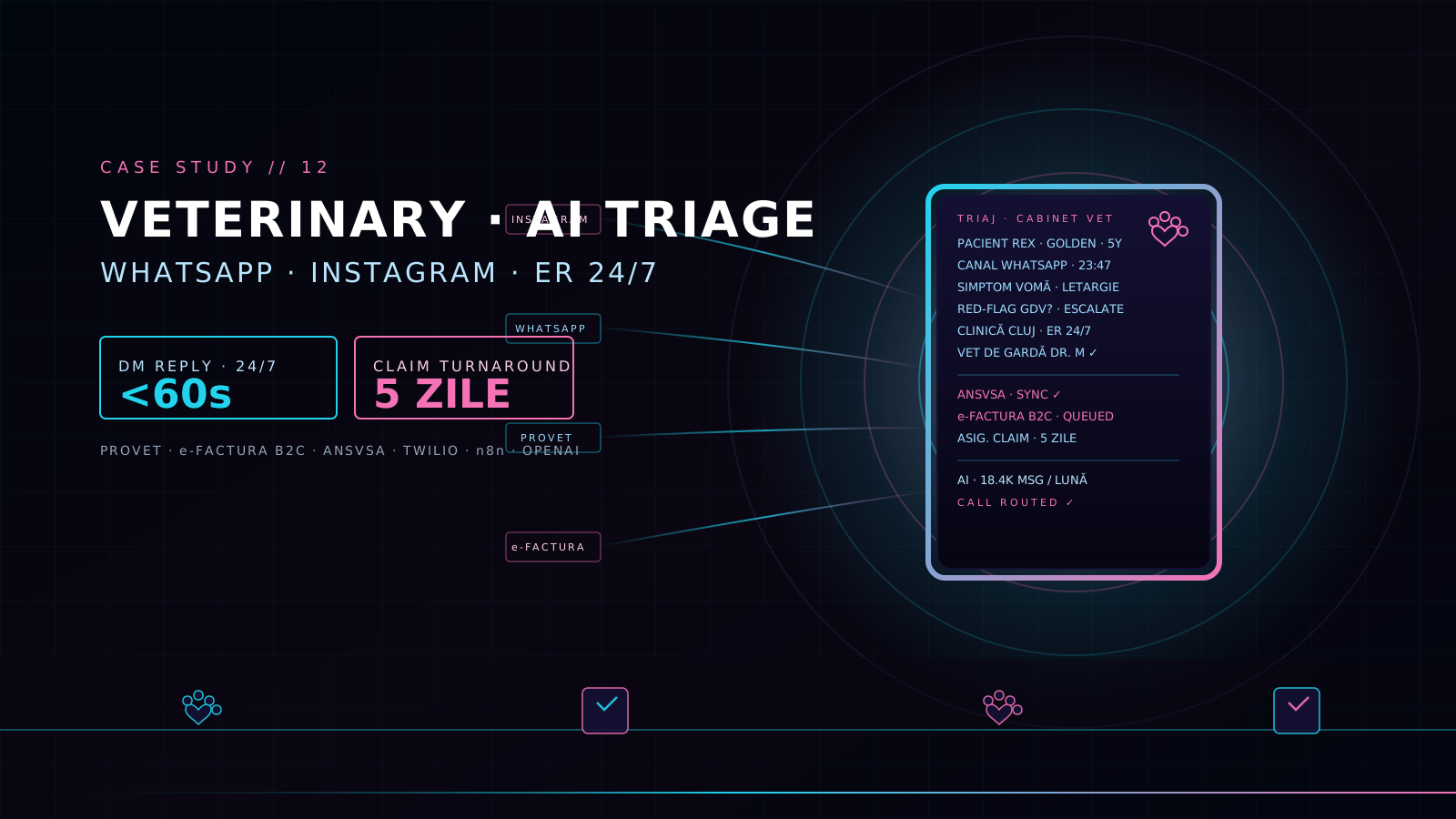
- 24/7 multi-channel concierge across WhatsApp, Instagram, Messenger, and the website chat: handles the 'is the X-ray included in the consult?' / 'how long after the vaccine can I bathe him?' / 'do you take Petfeliz?' flood in under 60 seconds, books non-urgent consults straight into ProVet with the right vet at the right clinic, and routes anything that smells clinical to a human in seconds — 84% of incoming messages now close without staff touching them
- Triage layer with hard escalation rules: a vet-approved set of red-flag questions (blocked urination, repeated unproductive vomiting, breathing distress, neuro signs, GDV symptoms, pyometra signs, ingestion of common toxins) jumps the message straight to the on-call vet's phone within 90 seconds, with a structured summary attached — no triage decision is made by the model, only routed
- Vaccine renewal engine: pulls due-dates from ProVet, sends a WhatsApp reminder at 21 / 7 / 1 days, lets the owner book in two taps, and re-tries with email or SMS if a channel goes silent — missed vaccine windows dropped 71% in the first quarter
- Insurance claim assembler: as soon as a paid invoice closes, the agent fetches the medical-history note, the diagnosis codes, the imaging and lab attachments, fills the carrier-specific form (we onboarded the three carriers covering ~90% of the clinic's insured book), and queues it for the practice manager to sign and submit — average turnaround fell from 9 weeks to 5 days
- e-Factura B2C engine: every transaction in ProVet generates a draft e-Factura that the practice manager reviews and submits to SPV ANAF the same day, with the structured XML stored against the patient and the owner — 100% B2C compliant since 1 January 2026, zero 'Operațiunea Cabinet' findings
- ANSVSA digital-cabinet sync: the prescription book, the antibiotic register (mandatory under EU Regulation 2019/6 since 2024–2026 phase-in), and the medical-waste e-DAS manifest are kept up to date against ProVet — so the team no longer recopies the same data into a paper register at the end of the day
- Multi-clinic, multi-vet scheduling co-pilot: when the AI books, it considers the right specialty (internal medicine vs. surgery vs. derm vs. exotics), the right vet on shift, the right clinic by drive-time from the owner, and the right room (radiology, surgery) — so the schedule stops looking like a Tetris game by 14:00
- Owner-portal digital health booklet: every pet gets a 'carnet de sănătate' online with vaccines, dewormings, weight history, allergies, past visits, and prescriptions, shareable with another vet on holiday in two taps — three of the clinic's biggest acquisition weeks in 2026 came from owners switching after a vacation emergency abroad
The results after one quarter
By the end of Q1 2026 the AI was handling 18,400 conversations a month across the four clinics with a median reply of under a minute, 24/7. Eighty-four percent of routine messages now close without staff, and the receptionists — the ones who used to spend their morning shoveling through last night's Instagram backlog — were redeployed onto in-clinic flow, the bit of the job they actually trained for.
After-hours triage caught what mattered. In its first twelve weeks the escalation layer pulled 412 messages out of the queue and put them straight on the on-call vet's phone with the red-flag answers already filled in. The medical director's read on the audit was that roughly thirty of those were the kind of case where 'wait until the morning' would have been the wrong answer — a urinary blockage cat, a bloated deep-chested dog, a chocolate ingestion at the wrong dose for the dog's weight. We make no clinical claim about those outcomes; what we can say is that the messages stopped sitting unread, and the on-call vet stopped finding a 06:47 SOS waiting on her phone in the morning.
Vaccine compliance was the quiet win. Missed renewal windows fell 71% versus the same period in 2025, which — combined with a small new-client bump from word of mouth and a tidier Instagram presence — lifted revenue per active patient 34% year over year. The insurance backlog, the one that had become an actual reputational problem, collapsed from 9 weeks to 5 days, and one of the three carriers asked us to pilot the same pipeline with another vet group on its book.
But the headline of the quarter was compliance. The B2C e-Factura mandate has been the quiet bonfire under Romanian small-animal practice this year — ANAF's first January–February sweep issued tens of millions of lei in fines, and at least one well-known Bucharest clinic was publicly named. Our client closed Q1 with every cash invoice in SPV the same day, a clean reconciliation against ProVet's day-book, and zero findings. Two friends of the founder, both running independent practices, switched their bookkeeping to the same workflow before 1 March.
What we'd do differently
We let the agent ask one extra triage question early on, to 'save the vet some time' — the kind of question a smart-but-untrained receptionist would ask ('how long has he been like this?'). It worked 99% of the time, and the 1% where it didn't, it accidentally implied a wait-and-see when the right answer was come-now. We rewrote the script with the medical director so that any red-flag answer ends the chat with 'stop, call us' and a routed phone call — no clarifying questions, no further probing. If you build vet triage and remember one thing, it's that you don't try to make the AI smarter; you make the escalation faster.
We assumed pet-insurance carriers would tolerate the same submission once and from then on the pipeline was solved. They didn't — two of the three changed their PDF form between February and April, one moved to an API mid-quarter, and one quietly started requiring a different lab report format. We rebuilt the connectors behind a single contract layer and added a weekly drift-check that screams when a field stops being accepted. The lesson: in any sector where the counterparty is a stack of 1990s back offices, your pipeline is only as fresh as your last failed claim.
The line we'd underline for any vet practice deciding whether to do this in 2026: automate the conversation and the paperwork, not the medicine. A human signs every clinical decision, every prescription, every e-Factura that ANAF will read, every insurance claim that goes out. The agent is allowed to be wrong about which vet is on shift this evening. It is not allowed to be wrong about whether the dog needs to be in surgery in the next hour — and the cheapest way to keep that line clean is to refuse to even try.
"We were drowning in DMs at midnight and losing pet owners to silence. The AI doesn't practice medicine — it just makes sure the right person sees the right message in the right minute. That, and getting every cash invoice into SPV before ANAF asked, is what bought us our quarter back."
— Medical Director & Co-Founder, veterinary chain