The problem
When AFM (Administrația Fondului pentru Mediu) relaunched Casa Verde Fotovoltaice in February 2026 with an €800M budget and a new platform that finally did not crash in the first eight minutes, our client got the call every installer in Romania got: the leads arrived in a flood. 2,400 form-fills in the first week. The installer dashboard turned into a graveyard of half-filled cards labeled „de sunat — luni".
The bottleneck was not selling. The team had been installing for nine years and could quote a 6 kWp rooftop in their sleep. The bottleneck was the dossier. Every Casa Verde Plus application is a 27-document beast: cadastral extract, beneficiary ID, ownership proof, technical project signed by an ANRE-certified electrician, declarations of conformity for every panel and inverter, the ATR (Aviz Tehnic de Racordare) from the local distribution operator — E-Distribuție, Delgaz or DEER depending on county — and an itemized cost breakdown that has to match the AFM eligibility matrix to the cent. Miss one signature and the file sits in the AFM queue for three weeks before anyone tells you what is wrong.
Then there is the DSO. E-Distribuție Muntenia in spring 2026 was running 38-day average turnaround on ATR requests. Delgaz in the North sat at 27. DEER Cluj — anyone's guess. Every project manager in the country had a personal contact at the local DSO that they would call whenever a file „rămânea blocat în sistem". The client had built a 14-person team and was still losing 1 in 4 sold projects to dossier abandonment, because the buyer got tired of waiting six months from contract to first kWh exported.
Post-install was the silent killer. After commissioning, the inverter pushed telemetry into Huawei FusionSolar or Solis Cloud, but nobody was watching. A string fault on a Saturday meant the homeowner noticed on Monday, called on Tuesday, and got a service truck on Thursday. By then a forum post about „instalatorul care nu mai răspunde" was already up on a regional Facebook group.
What we built
In Q1 2026 the right pieces finally lined up. AFM published v2 of its Casa Verde XML schema for dossier submission, OpenAI's vision models got accurate enough to read a Romanian cadastral extract from a phone photo, and the major Romanian DSOs — E-Distribuție especially — started accepting structured PDF submissions through their B2B portals. We wrapped all of it into a single AI back-office that sits between the lead form, the surveyor's tablet, the AFM portal, the DSO portal, and the homeowner's WhatsApp.
The client kept their existing CRM (a HubSpot setup from 2023) as the single source of truth. We did not replace it. We replaced the 13 things that were happening in 9 different inboxes around every project.
- AI lead qualifier on the Meta lead form: pulls the buyer's address, runs it against Google Solar API plus a national cadastral overlay, flags roof orientation and tilt, estimates available kWp, and rejects leads with north-facing roofs or apartment buildings before a salesperson opens the card — surveyor time on the road dropped 38%
- Same-day quote generator: from a rooftop photo plus the postal code and the customer's current ENEL/PPC consumption (uploaded with a one-tap photo of the last bill), the agent drafts a 6-page proposal with three system tiers, projected production, payback in months, and the Casa Verde net price — sent on WhatsApp before the surveyor even drives to site
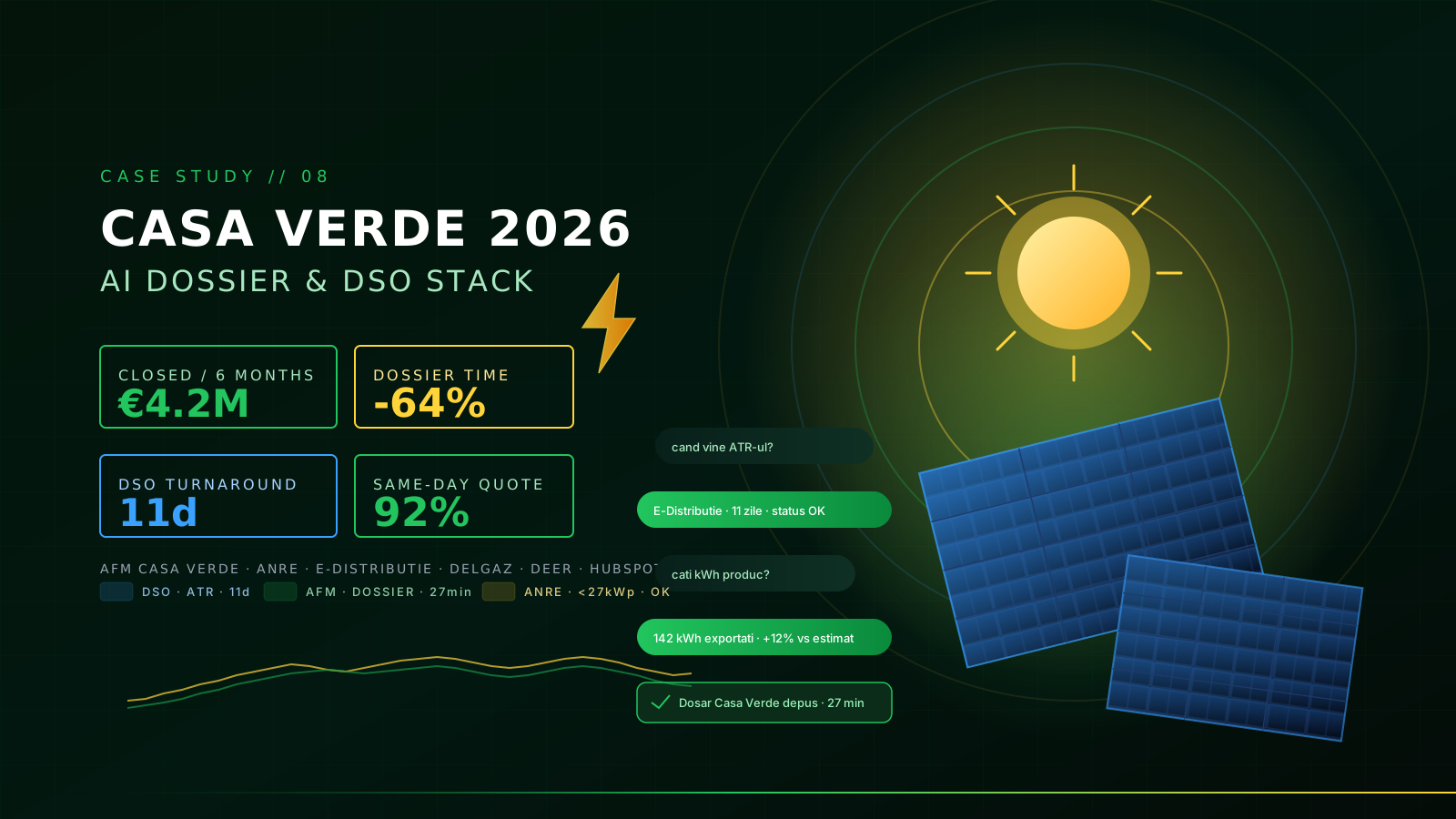
- Casa Verde dossier assembler: when a customer signs, the agent generates 24 of the 27 required documents from the CRM record (the other 3 are wet-signed via a one-tap DocuSign flow), validates each one against the AFM eligibility matrix, and submits the dossier through the AFM B2B XML endpoint — file completion dropped from 4–6 days to 27 minutes on average
- DSO submission and chase agent: detects the county and routes the ATR request to the right portal (E-Distribuție for Muntenia/Banat, Delgaz for Moldova/North-East, DEER for Transylvania), polls each portal twice daily, flags any clarification request with a pre-filled response draft, and updates the homeowner's WhatsApp thread automatically
- ANRE compliance check: every dossier is validated against the latest ANRE prosumer order before submission — the agent caught 31 cases in 6 months where the planned system would have crossed the 27 kWp prosumer limit and triggered a much heavier commercial procedure
- Heat pump bolt-on: when Casa Verde Plus Pompe de Căldură opened in April 2026, the agent automatically cross-sold every solar customer on natural gas with a heat pump dossier that reused 70% of documents already on file — added €620K to the pipeline in 8 weeks
- Inverter telemetry monitor: pulls data every 5 minutes from Huawei FusionSolar and Solis Cloud for every commissioned site, runs anomaly detection on string voltage and inverter temperature, and opens a service ticket before the homeowner notices a fault — average detection-to-resolution dropped from 4 days to 9 hours
- Homeowner WhatsApp concierge: a status thread per project — „dossier submitted", „ATR received", „commissioning scheduled Friday", „first 142 kWh exported this week" — kills the 80% of phone calls that were just „cum mai stă instalarea mea?"
- Post-install upsell: at month 6 after commissioning, the agent reads actual production against forecast and sends a tailored offer — for over-producers, a battery; for under-producers, a panel-tilt audit. Battery attach rate hit 22% in the first 6 months.
The results after 6 months
The team closed €4.2M in projects between February and August 2026, up from a €1.6M run-rate in the same window of 2025 — and did it with the same 14 people. The biggest unlock was Casa Verde dossier velocity: average completion dropped from 4–6 days to 27 minutes, which meant the team could submit the file the same day the contract was signed, before the typical 48-hour buyer's-remorse window.
DSO connection turnaround fell from a 38-day average (E-Distribuție territory) to 11 days. Not because the DSO got faster — it did not — but because the agent caught and resolved clarification requests within hours instead of letting them sit unread for a week. The team also stopped losing the „signed but never installed" tail: project abandonment dropped from 26% to 7%.
Post-install moved the numbers most installers never see: NPS at month 9 went from 41 to 78. The WhatsApp concierge alone killed 60% of inbound phone calls. And the inverter monitor caught 47 string faults in 6 months that would otherwise have rolled into either an angry call or a 1-star Google review — instead, the homeowner got a service text before they noticed the problem.
The upside the founder did not expect was Casa Verde Plus Pompe de Căldură. When that program opened in April, the dossier agent had already done 80% of the work for every solar customer in the pipeline; the team launched the heat pump line in 11 days and closed €620K of pump dossiers in the first 8 weeks, while competitors were still figuring out the AFM eligibility table.
What we'd do differently
We initially let the dossier agent auto-submit any file where every check returned green. Two weeks in, AFM rejected a small batch because a freshly updated form (Anexa 7-bis) had a new mandatory field our schema did not know about. We changed the policy: the first submission of each month gets a human eyes-on review, and any change in the AFM schema triggers a 48-hour manual freeze on auto-submission. We never lost another file to silent schema drift.
We also learned not to automate the homeowner photo collection. The agent used to ask for 6 site photos via WhatsApp. Romanian homeowners would send blurry shots of a roof corner with a finger over the lens, and the dossier would bounce. We switched to a 60-second video — the surveyor films the roof on site with a structured checklist on screen — and the photo bounce rate went to zero. The agent runs the workflow; the surveyor still does the human work that only humans do well.
Last lesson: never automate the discount conversation. If a buyer comes back asking for €800 off after a quote, a salesperson handles it. The agent would gladly knock €800 off because the model is trained to close. We blocked any pricing discussion at the agent layer and kept it human — net margin held at 14.2% while volume tripled.
"We didn't grow the team in 18 months and we still tripled volume. Casa Verde 2026 would have buried us without the dossier agent — instead we became the installer everyone gets recommended in the Facebook groups."
— Founder & general manager