The problem
Recruitment in Romania in 2026 has two clocks running at once and both ring „too late". On the local side, the labor market is so tight that whoever replies to a candidate first usually wins — and a CV that sits 9 days waiting for a callback is a candidate already working somewhere else. On the cross-border side, the government capped new non-EU worker admissions at 90,000 for 2026 (down from 100,000), and IGI processes the aviz de angajare on its own 30-day clock, so a dossier assembled slowly is a quota slot lost to a competitor's faster paperwork.
Our client ran ~5,000 placements a year across two offices — Bucharest for high-volume local roles (couriers, warehouse, retail, drivers, HoReCa) and Brașov for the construction and manufacturing labor that increasingly comes from outside the EU: Nepal, Sri Lanka, India, Bangladesh, Vietnam. The two sides shared one back office of 14 recruiters, an applicant tracking system bolted onto a 2018 CRM, and a single WhatsApp Business number that one overwhelmed coordinator answered between 9 and 6.
The numbers were brutal. Roughly 450 CVs landed every day across eJobs, BestJobs, OLX Locuri de Muncă, and the agency's own form. A recruiter could meaningfully screen maybe 40. The rest queued. Average time from application to first human contact was 9 days, and 61% of the candidates who did get a callback had already taken another job or simply stopped replying — „ghosting" wasn't a Gen-Z meme here, it was the single biggest line-item loss in the funnel.
The foreign-worker side was worse, just slower to bleed. Each aviz de angajare needs a stack — passport, attestat de calificare, criminal record, the employer's proof it advertised the role locally first, medical clearance, the lot — translated, legalized, and filed to IGI before a 180-day permit clock even starts. The coordinator assembled these in a shared Drive folder by hand. One missing apostille and the dossier bounced, the candidate waited another month in Kathmandu, and the construction client who needed 30 men on site in March got 18.
Then January 1, 2026 moved the floor. REGES-ONLINE replaced Revisal completely (HG 295/2025), and every new contract now has to be reported in the register at the latest the day before the person starts work — miss it and the fine is 3,000 to 8,000 lei per contract, plus another 3,000–6,000 for wrong data. With a few hundred placements a month and contracts sometimes confirmed at 7 p.m. for a 6 a.m. shift, the agency was one busy week away from a five-figure fine month. And looming over all of it: the EU AI Act now treats CV-screening software as „high-risk", meaning you cannot let an algorithm silently reject a human — there has to be a person, and a paper trail, behind every no.
What we built
We did not replace the recruiters or the ATS. We put an AI recruiting agent in front of the firehose and behind the compliance wall — it does the reading, the chasing, the dossier-building, and the filing; the recruiters do the judging and the humans-only decisions the law requires. Everything writes back into the existing CRM, so nobody had to learn a new screen.
The rule we set on day one — and the reason the agency's lawyer signed off — is simple: the agent can rank, summarize, message, and assemble, but it can never reject a candidate or sign a hire on its own. A person clicks every yes and every no.
- CV-screening agent: reads every incoming CV from eJobs/BestJobs/OLX/the web form within minutes, extracts skills, experience, location, languages, and right-to-work status, and ranks against the open role — but only shortlists for a human; it is structurally barred from auto-rejecting anyone, with the reason for each ranking logged for audit under the EU AI Act
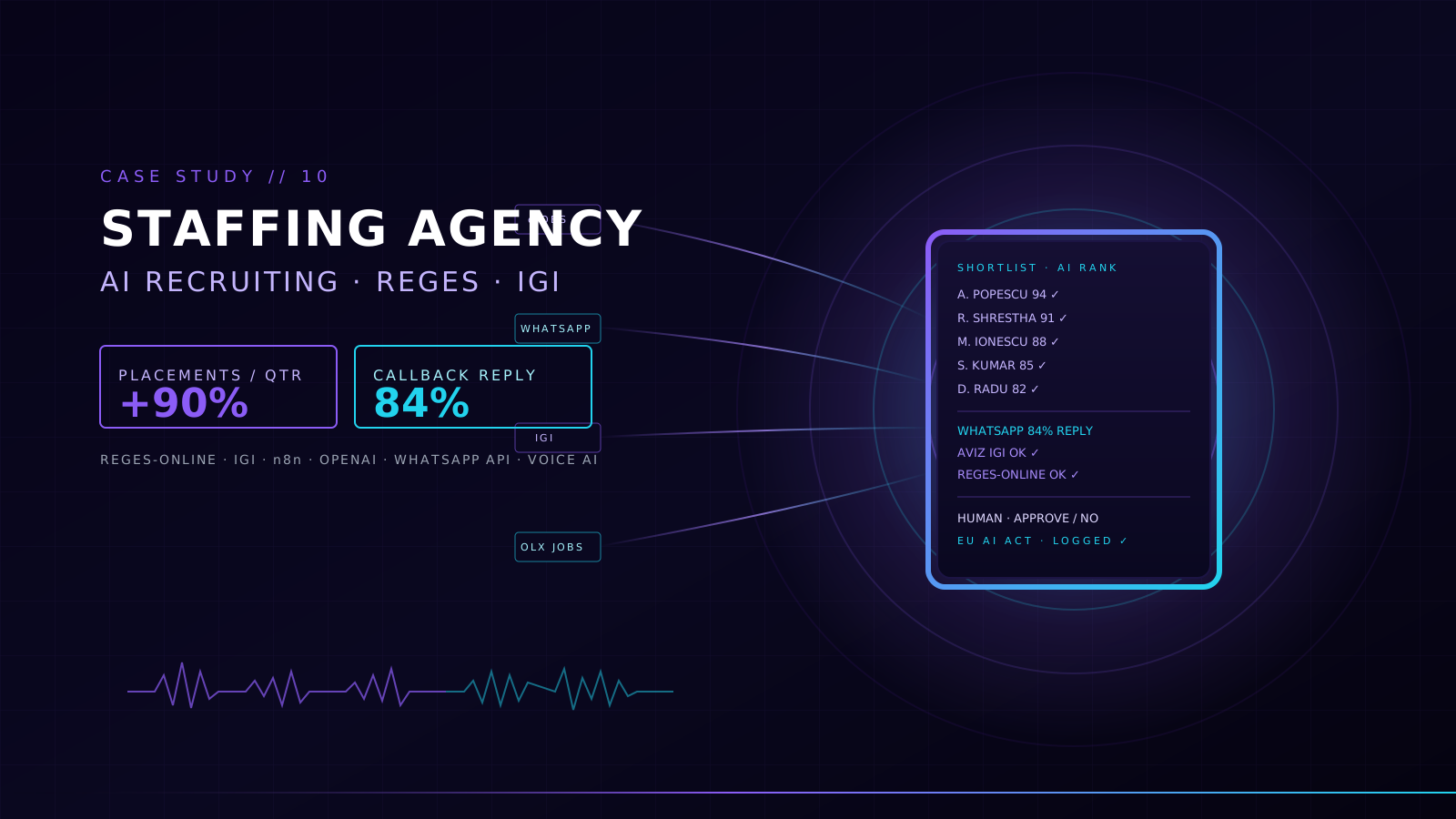
- 24/7 candidate WhatsApp / Viber concierge in 6 languages (RO/EN/HI/NE/UR/VI): answers within seconds, confirms interest, collects missing documents, books interview slots, and re-engages the candidate the agent can tell is about to ghost — candidate response rate to a callback jumped from 39% to 84%
- Voice agent for the candidate hotline: when someone calls the number from a job ad, the AI answers in their language day or night, screens for the role, and books straight into the recruiter's calendar — handling 73% of inbound calls end-to-end
- IGI aviz-de-angajare dossier assembler: builds the work-permit pack per candidate, checks every required document against the current IGI checklist, flags a missing apostille or an expired attestat before submission instead of after rejection, and tracks the 30-day IGI clock per file — dossier prep time fell from 6 hours to 35 minutes and the IGI bounce rate dropped from 23% to 4%
- REGES-ONLINE filing agent: the moment a contract is confirmed, it prepares the REGES submission and queues it for the HR officer to release before the day-before deadline — with an escalating alert on anything signed late in the day for an early shift, so nobody discovers the miss next month
- Local-market test automation: for foreign-worker roles, the agent posts and documents the mandatory local-advertising step (proof the job was offered to the Romanian/EU market first) so the IGI dossier carries clean evidence
- Compliance & bias guardrails: the agent is blocked from using name, age, gender, ethnicity, or photo as a ranking signal; every shortlist is sampled for adverse-impact drift; and every rejected candidate's data is auto-purged on the GDPR retention clock instead of living forever in a spreadsheet
- Recruiter dashboard: a live „who's about to ghost, which dossier is about to age out, which contract must hit REGES today" board that replaced four spreadsheets and a wall of sticky notes
The results after 90 days
Between February and April 2026 the agent screened 41,000 applicants — more than the whole team had touched in the previous year — and surfaced clean, ranked shortlists that recruiters could action the same day. Time from application to first contact collapsed from 9 days to 40 minutes. Because nobody sat unanswered, the placement count for the quarter nearly doubled — from 1,180 to 2,240 — on the same 14-person team.
On the cross-border side, the agency filed 1,900 IGI aviz-de-angajare dossiers in the quarter against the 2026 contingent, with the bounce rate down from 23% to 4%. The construction client that got 18 of 30 men last spring got all 30, three weeks early. The agency moved from „we'll try to fill it" to quoting a hard delivery date — and started charging a premium for it.
REGES-ONLINE was the quiet win. Zero late-filing fines across the quarter, against a realistic exposure that had been running 8–10 near-misses a month. The HR officer stopped staying until 8 p.m. on busy days to clear the register by hand.
The ghosting line item — the one nobody could fix by hiring — turned around hardest. Candidate callback response went from 39% to 84%, the agent re-engaging people on WhatsApp at the exact moment they were drifting. And the bias guardrails paid off in an unexpected way: when a corporate client's procurement audit asked for proof of non-discriminatory screening, the agency handed over an EU-AI-Act-ready log in an afternoon and won a 2-year framework contract on the strength of it.
What we'd do differently
Early on we let the agent auto-archive applications that scored below a hard threshold, to „save the recruiters time". It was the wrong call on every level — practically (it buried a few genuinely strong candidates whose CVs were just badly formatted) and legally (the EU AI Act does not let an algorithm be the one that says no). We ripped it out. The agent now ranks and explains; a human archives. Slower on paper, but it is the line between a tool and a liability.
We assumed a single multilingual prompt would handle candidate chat in all six languages equally. It did not — the Nepali and Urdu conversations needed different document examples and a gentler, more explicit tone about what IGI actually requires, because the cost of a misunderstanding (a candidate flying in with the wrong paper) is enormous. We split the flows by corridor and had native-speaking coordinators review the first few hundred conversations before trusting them.
Last lesson, the same one we relearn on every Romanian deployment: do not automate the relationship with the inspector. When ITM (Inspecția Muncii) or IGI calls, a person answers, and a person walks them through the file. The agent keeps the audit trail spotless so that conversation stays short — but a human has it. We have not had an inspection go sideways since.
"We used to lose half our candidates to a slow callback and half our permit slots to a missing stamp. This quarter we placed twice as many people with the same team, and not one of them sat waiting for us to call back. The recruiters finally do the part only a human can do."
— Founder & managing partner, workforce agency