The problem
For most of 2025 the client's X account was the cheapest acquisition channel they had. A small growth pod ran a classic engagement stack: listen for keywords around 'e-Factura', 'ANAF', 'n8n', and 'automatizare', auto-reply with a helpful-sounding take, drop a soft CTA, and route anyone who engaged into a nurture sequence. It was not elegant. It worked. Roughly 38% of demo bookings in Q4 2025 still traced back to an X thread the team had never written themselves.
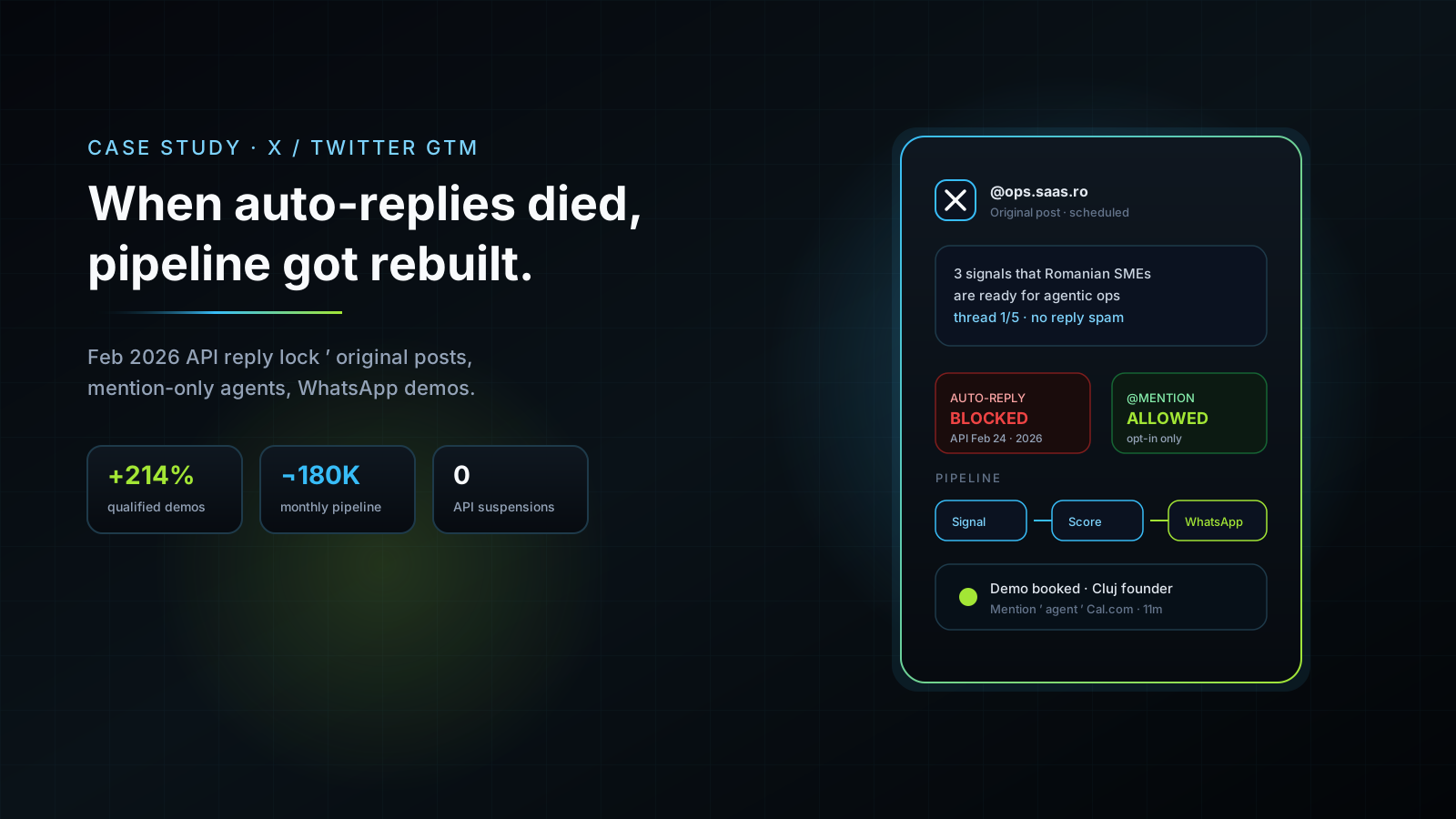
Then 24 February 2026 arrived. X updated the POST /2/tweets behaviour so that programmatic replies on Free, Basic, Pro, and Pay-Per-Use tiers only succeed when the original author has @mentioned the bot account or quote-posted it. Everything else returns blocked. Enterprise stayed exempt — at a price the 19-person team was not going to pay for a channel that was already getting noisier. By lunchtime every n8n workflow that replied into other people's conversations was failing. By the end of the week the growth lead had turned the whole reply layer off rather than risk an account suspension.
The hangover was worse than the outage. Original posting still worked, but the team had spent eighteen months optimizing for replies, not for posts that earned attention on their own. Impressions held for two weeks on residual algorithm goodwill, then fell. Demo requests attributed to X dropped 71% in three weeks. The founder started posting manually at 07:15 every morning from his phone, which bought back some reach and burned four hours a day he did not have. Instagram Reels still brought curiosity DMs, but those sat unanswered until a sales rep opened Meta Business Suite after lunch — and by August 2026, with Meta Business Agent's free window closed and token billing live at $2 per million tokens, blindly turning every DM over to Meta's native agent was suddenly a line item, not a free experiment.
The brief we got in late March was blunt: keep X, stay off Enterprise, stop farming other people's threads, and make the channel produce pipeline again before the summer hiring freeze. They also wanted whatever we built to respect the spirit of the new rules — no browser automation pretending to be a human, no identical multi-account posting, no engagement loops. If the API said replies need an invitation, the stack would wait for the invitation.
What we built
We threw away the reply farm and rebuilt around three jobs the platform still allows: publish original content at a human cadence, answer when someone explicitly invites you into the conversation, and move serious buyers off X into a channel where a sales conversation actually closes. The AI does drafting, scoring, and routing. A human still presses publish on anything that carries the founder's name, and a human still joins every demo.
The operating rule we wrote on the whiteboard on day one: if a workflow would have been blocked by the February 24 API change, it does not get a clever workaround. It gets deleted. That single constraint killed half the backlog of 'growth ideas' in an afternoon and forced the design toward assets the company actually owns — threads, signal monitoring, and opt-in mentions.
- Original-content engine: weekly research brief → AI-drafted thread and single posts in the founder's voice → human edit in Typefully → scheduled publish via the official API (original posts, not replies). Evergreen winners get recycled on a 45-day cool-down, never cloned across secondary accounts
- Mention-and-quote agent only: when someone @mentions or quote-posts the brand, an agent drafts a contextual reply inside the allowed API path, flags anything that looks like a buying question, and either posts the short reply or escalates to the founder within five minutes — no keyword spraying into strangers' threads
- Public-signal listener (read-only): watches ICP founders and operators talking about e-Factura pain, hiring ops people, or switching ERPs; scores fit on six axes (stage, headcount, stack, geography, buying language, timing); never auto-replies — queues a founder-authored comment suggestion or a warm LinkedIn/WhatsApp path instead
- WhatsApp demo router: high-intent mentions and form fills get a Cal.com link and a WhatsApp Business follow-up in Romanian or English within minutes, with the X thread context attached in HubSpot so the AE is not starting from zero
- Instagram DM triage with cost guardrails: Reels still drive discovery; a lightweight agent answers FAQs and books demos, but long catalogue-style chats that would burn Meta Business Agent tokens get truncated and handed to a human before the August 2026 token meter runs away
- Compliance and brand safety layer: blocklist for political bait, competitor pile-ons, and 'engagement farming' patterns; audit log of every automated reply proving it was triggered by a mention or quote; weekly suspension-risk review with the founder
- Pipeline dashboard: X impressions, mention volume, signal→score→demo conversion, WhatsApp response time, and revenue influenced — one Slack digest at 08:00 so the team stops living inside analytics tabs
The results after one quarter
By the end of Q2 2026 the rebuilt stack was producing €180K a month in qualified pipeline attributed to X-originated conversations that completed on WhatsApp or a booked demo. That was not a return to the old reply-farm volume — total automated replies fell more than 90% — but the replies that remained converted. Demo bookings from the channel sat 214% above the March trough and about 18% above the pre-crackdown baseline, with a cleaner ICP mix and far fewer 'curious students' burning AE time.
Speed mattered as much as volume. Median time from an inbound @mention that smelled like a buying question to a WhatsApp conversation with a Cal.com link attached dropped to 11 minutes during business hours. The founder stopped doing 07:15 doom-scrolls; he now spends roughly 40 minutes reviewing the day's draft queue and mention escalations, then gets back to product. Instagram stopped being a black hole of unread DMs without handing the entire conversation budget to Meta's metered Business Agent.
The soft metric the team cared about most: zero API suspensions, zero 'we think you're a bot' warnings, and a public timeline that finally looked like a product company instead of a reply bot with a logo. Two design partners who had muted the old account came back into demos after a thread on Romanian SME ops debt went mildly viral inside the Cluj–Bucharest founder circle — the kind of reach you cannot buy by arguing under somebody else's viral post.
What we'd do differently
We over-indexed on thread volume in the first three weeks — five long threads a week sounded like a strategy and read like noise. The algorithm and the audience both preferred two sharp threads and three short observational posts. We cut the quota and quality went up; the lesson is that when you lose reply distribution, you cannot replace it with more of your own words. You replace it with better ones.
We also tried to make the signal listener 'helpful' by auto-sending a drafted comment for the founder to one-tap publish on other people's posts. Technically that is not an API reply from the bot account, but it still felt like the old playbook with extra steps, and the founder hated it. We killed the one-tap publish path and kept the listener as a research brief only. If the company wants to join a conversation, a human types the join.
The line we would underline for any B2B team staring at the February 2026 X rules: do not buy Enterprise just to resurrect a spam habit, and do not pretend browser automation is a strategy. Automate what the platform still blesses — original publishing, mention-triggered service, scoring, and the handoff into WhatsApp — and treat everything else as content craft. The crackdown did not kill distribution on X. It killed the illusion that distribution was a reply script.
"Our whole X motion was a reply bot with a SaaS logo on it. When the API closed that door in February, we finally had to become worth following. The stack we run now posts less, answers only when invited, and somehow books more demos — which is the quietest indictment of the old playbook I can think of."
— Founder & CEO, Cluj operations SaaS