The problem
By late summer 2026, Romania's residential solar story had flipped. Midday overproduction was pushing wholesale prices toward zero or negative while evening peaks still imported expensive power — and Acting Prime Minister Ilie Bolojan was saying out loud what every DSO dispatcher already knew: more panels without storage hurt the grid. On Instagram and X, the Reels that travelled were no longer 'look at my new roof' — they were 'why is my inverter curtailing at noon?' and 'cum adaug baterie pe Casa Verde?'. Our client, a 19-person retrofit crew that had grown up installing PV and then specialised in storage add-ons across Bucharest, Ilfov, Ploiești, and Constanța, suddenly had the demand side of a decade in six weeks.
Then the Ministry of Environment put numbers on it. A 400-million-lei AFM programme aimed at existing prosumers — individuals with grid-connected PV, whether Casa Verde alumni or privately financed — drafted grants of up to 15,000 lei including VAT, covering up to 75% of eligible costs, capped around 1,250 lei/kWh, with a minimum storage capacity of 12 kWh and installation by ANRE Type B (or EU-equivalent) technicians. Selection moved toward points, not pure first-come-first-served. MySMIS applications were framed for a September–October window. Overnight, every homeowner with a working inverter became a lead — and every lead opened WhatsApp with the same three questions: am I eligible, how many kWh, how fast can you file.
The old stack could not survive that volume. A typical booked survey burned 12–16 free-form messages: inverter brand and serial, existing PV kWp, monthly bills, single-phase vs three-phase, photos of the meter and plant room, 'does AFM cover hybrids?', 'my neighbour got 10 kWh — is 12 mandatory?', 'can you guarantee the points?'. Median first reply in office hours was acceptable. After 19:00 — when Reels about evening blackouts peaked — it drifted past ninety minutes. Speed-to-lead was the marketing slide; the inbox was Tuesday morning.
Meta moved the cost floor at the worst possible time. Romania had already been pulled onto a higher standalone utility and authentication rate card around 1 July 2026. On 1 August Meta Business Agent replies started billing per token — roughly four to five US cents a chatty turn if you outsource the voice to Meta's own agent. On 1 September the October rate card landed: from 1 October every service message (human or third-party AI free-form reply inside the 24-hour window) and every in-window utility template becomes chargeable at that utility rate, with only 1,000 free service messages per business phone number per month, no rollover, no volume discount on service. No payment method on the WABA by 30 September and Meta stops delivering service messages when charging begins. Running a 14-message AFM checklist on three shared numbers through the September rush was about to become a five-figure lei surprise — or an outage.
Governance was the quieter risk, and it was trending hard on X and LinkedIn all summer: agentic systems yanked from production because they sounded sure. A long-prompt 'sales AI' the team had trialled happily invented AFM point scores, implied a 10 kWh pack would 'probably be fine' against a 12 kWh draft floor, and once told a homeowner the DSO notification was 'already handled'. EU AI Act Article 50 transparency had been live since 2 August 2026 — the first message has to say it is AI, in plain language. They needed fewer messages, faster structured intake, honest disclosure, and a hard stop before subsidy claims or engineering left the chat.
What we built
We did not buy Meta Business Agent. Token-billed native agents are the wrong tool when your October problem is message count and your compliance problem is overconfident subsidy and sizing claims. We built a short, scoped custom agent on WhatsApp Business API + Instagram Messaging, with WhatsApp Flows as the intake backbone, and we treated every free-form reply as a cost that had to earn its existence before 1 October.
Three rules with the technical director on day one. First: the AI never confirms AFM eligibility, never invents a points score, and never says a grant is 'approved' — it can collect documents and flag missing fields for a human. Second: the AI never locks a final kWh design or a binding price; catalogue ranges are labelled non-binding and every number that could be read as a quote routes to an estimator after a site survey. Third: every conversation opens with an Article 50 disclosure in the first sentence. Those three rules also keep the system on the right side of the governance failure mode that has been looping across X all year: autonomy without a human gate.
- Instagram Reel comment-to-DM bridge keyed to autumn storage creative: triggers on 'baterie', 'AFM', 'stocare', 'prosumator', 'kWh', 'preț' open a DM in under 30 seconds with the Art. 50 line and one CTA into WhatsApp Flows — so viral evening-peak Reels stop dying in the comments
- WhatsApp Flows intake instead of checklist tennis: existing PV kWp, inverter brand/model, single- vs three-phase, monthly consumption pattern, property type, photos of inverter / meter / plant room, preferred county (Bucharest / Ilfov / Ploiești / Constanța), and survey window — one structured session replaces 8–10 free-form turns
- AFM dossier co-pilot (human-validated): assembles a MySMIS-ready pack from Flow answers — prosumer proof, ID, property docs, no-prior-storage attestation, tax-clearance checklist — and flags gaps; the agent never claims the homeowner 'will score X points' or that AFM will pay
- Short custom reply agent (not Meta Business Agent): answers catalogue FAQs from a vetted knowledge base (min. 12 kWh draft floor, ANRE Type B install requirement, 75% co-funding framing as 'programme draft / guide rules'), refuses to invent savings-in-lei/year, and escalates anything that smells like electrical fault or DSO dispute to a human in one turn
- Message-budget co-pilot ahead of 1 October: live counter per phone number against the 1,000 free service-message tier, preference for Flow replies and approved utility templates over chatty text, and an alert at 70% of the monthly free tier so ops can open a second number or throttle Meta ads
- Estimator hand-off pack: every booked survey lands in the CRM with Flow answers, photo set, drive-time slot, and a draft non-binding storage range for the human to edit — technicians stop rebuilding the brief from a 40-message scroll
- Payment-method and WABA hygiene shipped by mid-September: billing on file before the 30 September cutoff, utility templates for survey booked / technician en route / docs missing / job closed, and a kill-switch that pauses non-essential outbound if a number approaches the free-tier ceiling in October
- Post-survey e-Factura + deposit workflow after a human-signed offer: deposit link, structured invoice queue, and a utility-template status path that stays cheaper than free-form 'did you upload the bill?' nagging once October rates apply
The results after six weeks
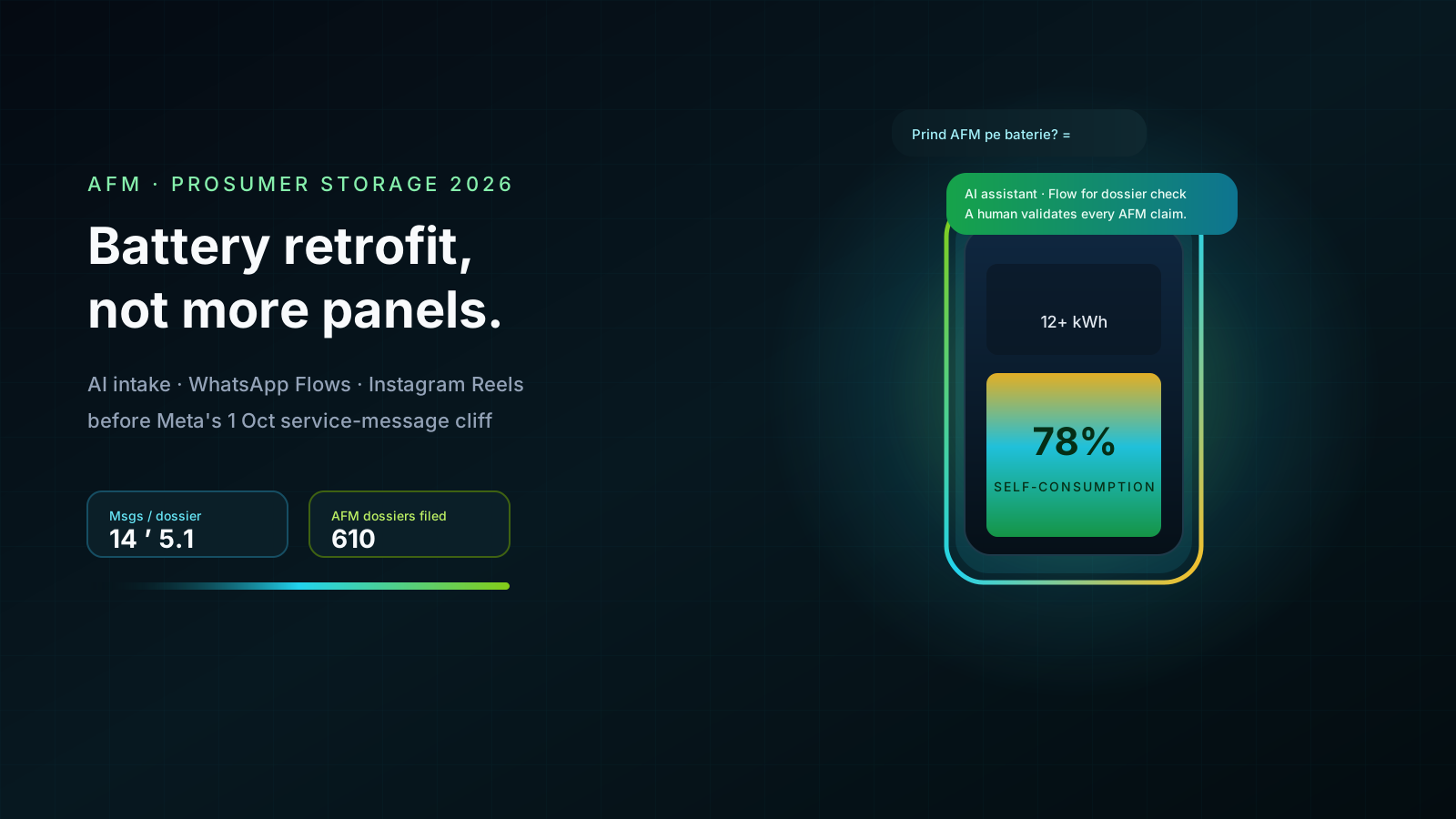
By the second week of September the stack was carrying the AFM rush without adding headcount. The AI and Flows layer handled the conversation volume that used to bury two coordinators; median first reply on Instagram and WhatsApp fell under a minute, 24/7, including the 21:00 Reel spikes. Average WhatsApp messages per booked survey dropped from 14 to 5.1 (−64%), which is the number that mattered once every service bubble carried a Romania utility-rate price tag.
On the commercial side, survey-to-signed-contract rose 28% versus the July–August baseline. Estimators arrived knowing the inverter model, the phase setup, and whether the homeowner already had a storage unit (an AFM disqualifier under the draft guide) — so fewer site visits died as 'we need another trip for photos'. In six weeks the team assembled 610 AFM-oriented dossiers with a human signing every eligibility and engineering claim before anything touched MySMIS.
October cost modelling flipped from panic to boring. With Flows absorbing the checklist and utility templates covering status, two of the three WhatsApp numbers projected under the 1,000 free service-message tier for October even at September lead velocity; the third sat close enough that ops pre-provisioned a fourth number instead of letting Meta ads keep pouring into a billable abyss. Payment method was on every WABA by 22 September — three soft reminders from the co-pilot, zero heroics on the 30th.
The brand side was quieter but real. Article 50 disclosure in the first sentence did not kill conversion; homeowners treated 'you're chatting with an automated assistant; a technician validates every AFM claim and every offer' as a feature after a summer of viral overconfident bots. The founder stopped posting apology Stories about missed DMs and started posting install timelapses again — which, predictably, created more comments for the bridge to catch.
What we'd do differently
We under-invested in the comment-to-DM bridge in week one of the first AFM creative flight. Organic comments sat looking healthy while the DM agent waited for people who already knew to write first — and Romanian Instagram users often skip that step. Wire the keyword bridge before you boost the Reel, not after you notice a pretty comment thread with zero surveys behind it.
We let the FAQ agent answer 'cât e pentru 10 kWh' with a wide catalogue range too early. Homeowners read ranges as offers, and the draft AFM floor at 12 kWh made undersized curiosity dangerous. We now refuse final kWh pricing in chat entirely: Flow → survey → human range. If you remember one battery-specific rule for autumn 2026, make it that — especially while X and LinkedIn keep recirculating agentic rollbacks where models sounded commercially sure.
We almost 'saved time' by turning on Meta Business Agent for after-hours overflow. The token economics and the long, confident answers would have hit both the October message cliff and the Art. 50 / no-eligibility-claim rules. Short custom agents plus Flows beat a chatty platform agent when your KPI is billable messages per dossier, not words generated. Put the payment method on the WABA by 30 September, count messages the way you count diesel for the vans, and let a human sign every figure that touches MySMIS or a contract.
"1 October was going to turn our Instagram success into a WhatsApp tax right as AFM opened. Flows cut the chatter, the bot announces itself and never signs eligibility or a quote, and the crew arrives already knowing the inverter. That's the automation I pay for — not a more talkative agent."
— Managing partner, residential battery & hybrid PV retrofit installer