The problem
If you run a private lab in Bucharest in 2026, your reception desk does not sound like a clinic — it sounds like a call centre for one sentence. Between 07:30 and 11:00 the phones ring with patients who drew blood yesterday and want to know if the CBC, TSH, or vitamin D panel is in. The answer is almost always in the LIS already. The human just has not had thirty seconds to look it up, copy a portal link, and paste it into WhatsApp. Multiply that by 2,800 draws a week across seven collection points and you get a morning that never starts.
The second leak was Instagram. Opticians and dermatologists send patients to the lab with a Reel or a Story swipe-up; the patient DMs “trebuie să fiu pe nemâncate?” at 22:40 and gets silence until the next morning — by which time they either skipped breakfast wrongly, arrived unprepared, or booked somewhere else that answered. Comment-to-DM was on, but the 2024 keyword bot treated every “pret” the same and could not tell a lipid panel from a urine culture.
Then Meta changed the economics underneath the whole inbox. On 1 August 2026 Meta Business Agent left its free test window and started billing at $2.00 per million tokens across WhatsApp, Instagram, and Messenger — roughly 4–5¢ for a typical AI reply. The lab had flipped Meta’s native agent on in July because it was free and “good enough.” By the second week of August the token invoice was already larger than the old ManyChat plan, mostly because the agent rewrote long, polite essays for “is my CRP ready?” instead of a one-line status + secure link. Worse: on 1 October 2026 Meta ends the free ride for ordinary service messages and in-window utility templates. Every free-form “your results are ready” that is not carefully designed becomes a recurring line item — just as Romania’s broader digital-health push (electronic prescriptions, referrals, and medical letters moving onto a single platform through 2026) is training patients to expect instant digital answers, not a callback after lunch.
Compliance sat on top of the chaos. Result PDFs are special-category health data under GDPR; a wrong-number WhatsApp with an open attachment is an incident, not a “oops.” Private-pay invoices still need RO e-Factura B2C inside five working days. And from 2 August 2026, EU AI Act Article 50 transparency rules mean the bot has to disclose it is an AI at the start of the chat — ANCOM has already started pointing Romanian consumer-facing bots at that duty. The founder’s brief was blunt: stop the phone queue, stop burning tokens on fluff, and do not create a data-protection story while you are at it.
What we built
We did not put Meta’s native Business Agent in charge of medical results. We built a controlled agent on the WhatsApp Business API and Instagram Conversations API that is allowed to book, explain prep, and notify — and is forbidden from interpreting labs, suggesting treatments, or inventing turnaround times. Every outbound results message carries a short-lived, authenticated portal link, never an attached PDF in the chat. A human still signs clinical callbacks, disputed invoices, and anything that smells like a diagnosis question.
The design also assumed October. Instead of chatting for eight turns to say “ready,” the agent resolves status in one or two messages, prefers template utility notifications where they still make sense, and collapses Instagram DMs into WhatsApp once identity is verified — because Instagram is great for acquisition and terrible as a medical document channel. Token spend became a product requirement, not an afterthought.
- 24/7 booking concierge on WhatsApp + Instagram: picks collection point by drive-time, maps the ordered panel to the right chair time (fasting vs. non-fasting lanes), and writes the slot straight into the LIS schedule — no double-books across the seven points
- Prep engine: after booking, the agent sends panel-specific fasting, medication, and sample rules in Romanian (and English for expats), with a T-12h reminder that only fires if the appointment is still active — no-show rate on fasting draws dropped hard in week three
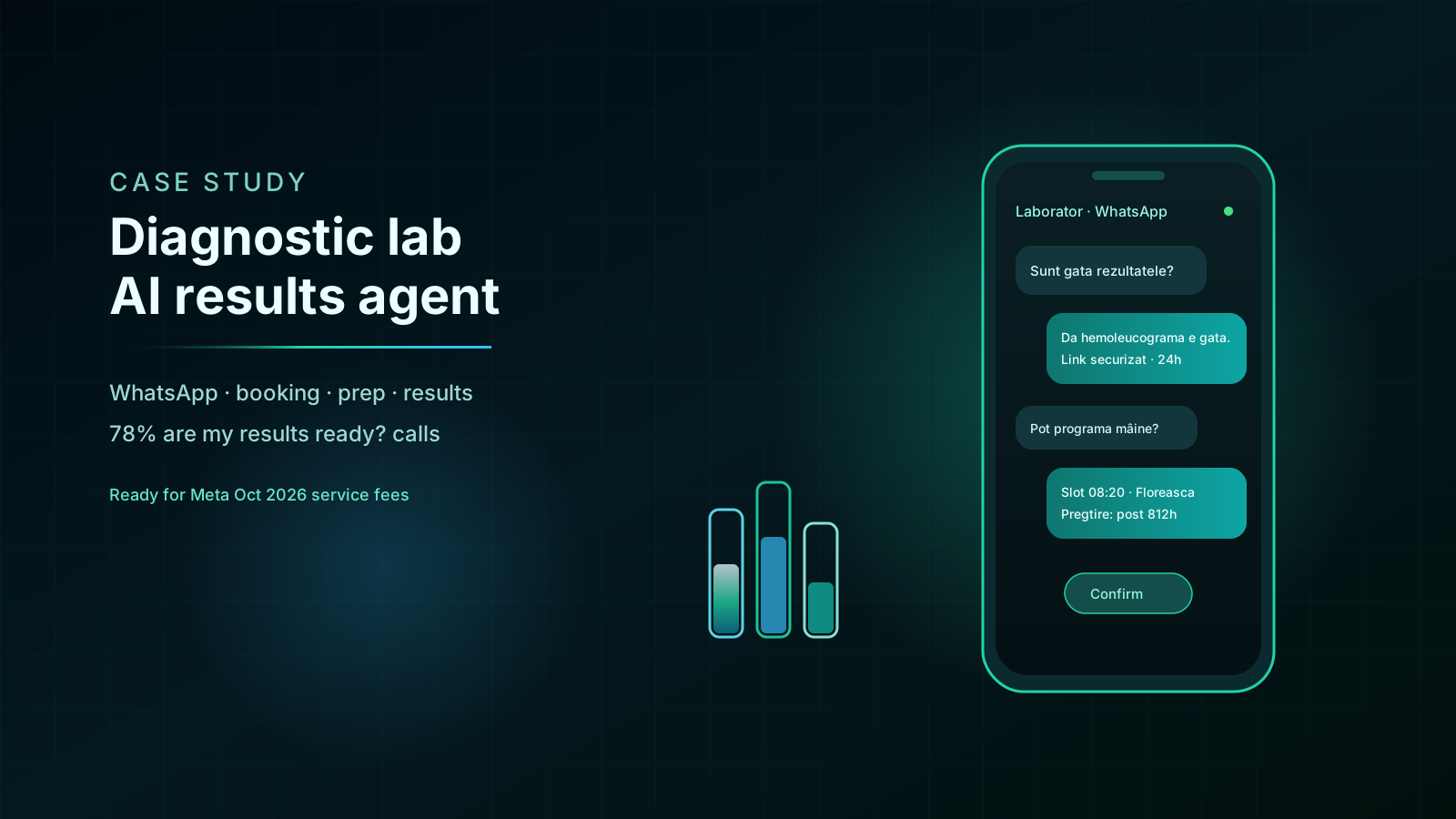
- Results-ready notifier wired to the LIS: the moment a panel flips to validated, the patient gets a WhatsApp utility-style ping with a 24-hour signed link to the patient portal; the agent never pastes values into chat and never attaches the PDF
- “Is it ready?” short-circuit: if the patient asks early, the agent checks LIS status and answers with ETA or the secure link — one reply, not a paragraph — which is what killed most of the morning phone pile
- Meta token & October-fee guardrails: hard max tokens per turn, canned status micro-copy instead of generative essays, early handoff to WhatsApp from Instagram, and a weekly cost dashboard so ops sees €/1,000 conversations before 1 October 2026 service-message billing lands
- EU AI Act Art. 50 disclosure + GDPR gates: first bot message states it is an automated assistant; identity step (CNP last digits + collection code or portal OTP) before any result link; full audit log of who saw what, when
- CNAS / SIPE-aware FAQ without claiming settlement: the agent explains which panels are typically private-pay vs. referred, what documents to bring, and when to talk to a human about compensation — it does not promise CNAS coverage
- e-Factura B2C draft queue for private-pay visits: when payment clears at the collection point, a structured invoice draft is staged for the finance lead to submit to SPV ANAF the same day
- Escalation desk: abnormal-flag callbacks, angry billing threads, pregnancy/pediatric edge cases, and any request to “tell me if this is bad” jump to a biomedical scientist or shift lead inside two minutes
The results after one quarter
By mid-August 2026 the pattern was obvious on the switchboard report: result-status phone calls were down 78% versus the prior quarter, even though draw volume was up. Reception finally started the day with patients in chairs instead of a blinking call queue. Median first reply on WhatsApp and Instagram sat under 45 seconds from 06:00 to 22:00, and 81% of routine threads closed without a staffer opening the transcript.
Collection-slot utilisation rose 31% on the same furniture. The unlock was boring and valuable: fasting patients arrived actually fasting, non-fasting panels stopped clogging the 07:00 lane, and Instagram leads that used to die overnight now held a confirmed slot before midnight. Private-pay revenue per chair-hour moved with utilisation; the owner stopped talking about “hiring two more receptionists before autumn.”
On the Meta bill, the July “free agent” experiment had been teaching the wrong lesson — that unlimited generative replies were free. After we replaced essay-length status answers with short, tool-backed messages and moved results off Instagram into verified WhatsApp links, AI token spend fell 62% from the mid-August peak while resolution rate went up. The lab is not pretending October will be free; it is walking in with a measured € per conversation and a template strategy instead of a surprise invoice on 2 October.
What we'd do differently
We almost shipped result values inside the WhatsApp bubble “for convenience.” Legal stopped it in review, correctly: convenience is how you get a screenshot forwarded to a group chat. The portal-link pattern is slower by one tap and infinitely safer. If you automate lab comms, treat the chat as a doorbell, not a medical record.
We also underestimated how many patients would try to turn the bot into a doctor (“e grav?”). The first week produced charming, over-helpful drafts from the model. We hard-switched those intents to a human callback script and added a visible Art. 50 line so nobody thought a machine had cleared their CBC. Automate logistics. Do not automate reassurance about pathology.
Finally: if you turned on Meta Business Agent in July because it was free, audit it before October. The token meter and the coming service-message fees punish chatty agents. The winning lab agent in 2026 is brief, tool-using, identity-gated, and allergic to interpreting bloodwork.
"Our mornings used to be a hundred people asking if the TSH was in. Now the phone rings when something is actually wrong — and that is the only time we want it to ring."
— Operations director, private diagnostic lab chain