The problem
Running a mid-size digital agency in Romania in 2026 is two businesses stacked on top of each other. The first is the one clients see: strategy decks, Reels, paid media, reporting calls. The second is the one that kills margin: turning every client podcast, webinar, and founder interview into a dozen platform-native formats before Tuesday's stand-up — while six other clients need the same thing, in Romanian and English, with different brand voices, and nobody wants to pay for six more editors.
Our client had grown from a four-person performance shop in 2021 to a 22-person agency with 38 active retainers — restaurants, fintech startups, medical clinics, a solar installer, two law firms. Revenue was up. So was the content tax. A single 45-minute client webinar that should have become an SEO blog, three Instagram carousels, an X thread, two LinkedIn posts, a newsletter, and four Shorts was instead consuming 11–14 hours of junior copywriter time because every platform wanted a different hook, length, and tone. Cross-posting the same caption — the lazy default when you're behind — was getting flagged on Instagram and buried on X. The agency's own X account had started a thread in March that got 40% less reach than a rewritten version posted two days later; the team knew the data but didn't have the hours to act on it.
Instagram was the loudest pain point. Clients were posting Reels that hit 200,000 views and then going silent in the DMs because nobody had bandwidth to answer 'how much?' at 23:00. The agency had sold comment-to-DM and DM concierge setups to three beauty clients — and knew how well they worked — but couldn't productize the workflow across the roster without tripling headcount. Meanwhile, the same clients were asking why their competitor's agency shipped five carousels a week and they got two.
Shadow AI was the problem nobody put on the roadmap until it almost ended a contract. In April 2026 a junior strategist, racing a Sunday deadline for a fintech client's quarterly narrative, pasted a stripped-down revenue dashboard — client name still in a cell header — into a personal ChatGPT Plus tab to 'clean up the copy.' The session wasn't logged, wasn't in the client's folder, and wasn't covered by any data-processing agreement. The client's compliance officer found out Tuesday because the strategist reused a phrasing so specific it matched a slide that had never left the shared drive. The Cloud Security Alliance had just published its May 2026 shadow-AI report: 98% of organizations reported unsanctioned AI use; 86% lacked visibility into how data flowed to AI tools. The agency was not an exception — it was the archetype. Seven people admitted, in a Monday all-hands, to using personal AI accounts for client work. None of them could say which client data had touched which model.
Then the external deadlines stacked. The EU AI Act's next enforcement milestones for general-purpose AI transparency and documentation landed in Q3 2026, and two of the agency's clients — a payments startup and a clinic group — started asking for AI inventories in vendor questionnaires. Meta tightened enforcement on identical cross-posts and low-engagement automated comment replies — exactly the hacks the team had been using to survive the content backlog. ANAF's e-Factura expectations had already trained Romanian SMB owners to care about audit trails; now their marketing vendors needed the same. The founder's line at the emergency offsite: 'We either become the agency that governs AI and ships at scale, or we become the cautionary tale in the next CSA whitepaper.'
What we built
We didn't ban AI — that was never going to work in a room full of people paid to move fast. We built a sanctioned stack that was faster than shadow AI, with guardrails that satisfied GDPR, the EU AI Act's documentation expectations, and the client's procurement team. One workspace per client. One repurposing pipeline per pillar asset. One approval gate before anything touched Instagram, X, or a paid ads account.
Two rules from day one. First: no client data in a personal AI account, full stop — if the sanctioned tool is slower, we fix the tool, we don't route around it. Second: AI generates drafts and variants; a human with the client's brand guide approves every external-facing asset. The agency's creative director kept veto power on tone; the pipeline handled volume.
- Sanctioned AI workspace (Claude for Work + agency-owned OpenAI enterprise tenant) with per-client folders, no-training contracts, and SSO — personal ChatGPT tabs blocked on agency devices within two weeks, with a free tier of the enterprise tool so nobody felt punished
- Shadow-AI discovery pass: one-week audit of browser extensions, pasted-text patterns, and shared-drive filenames that had leaked into public model prompts — produced a client-data classification sheet (public / internal / restricted) that became the intake checklist for every new brief
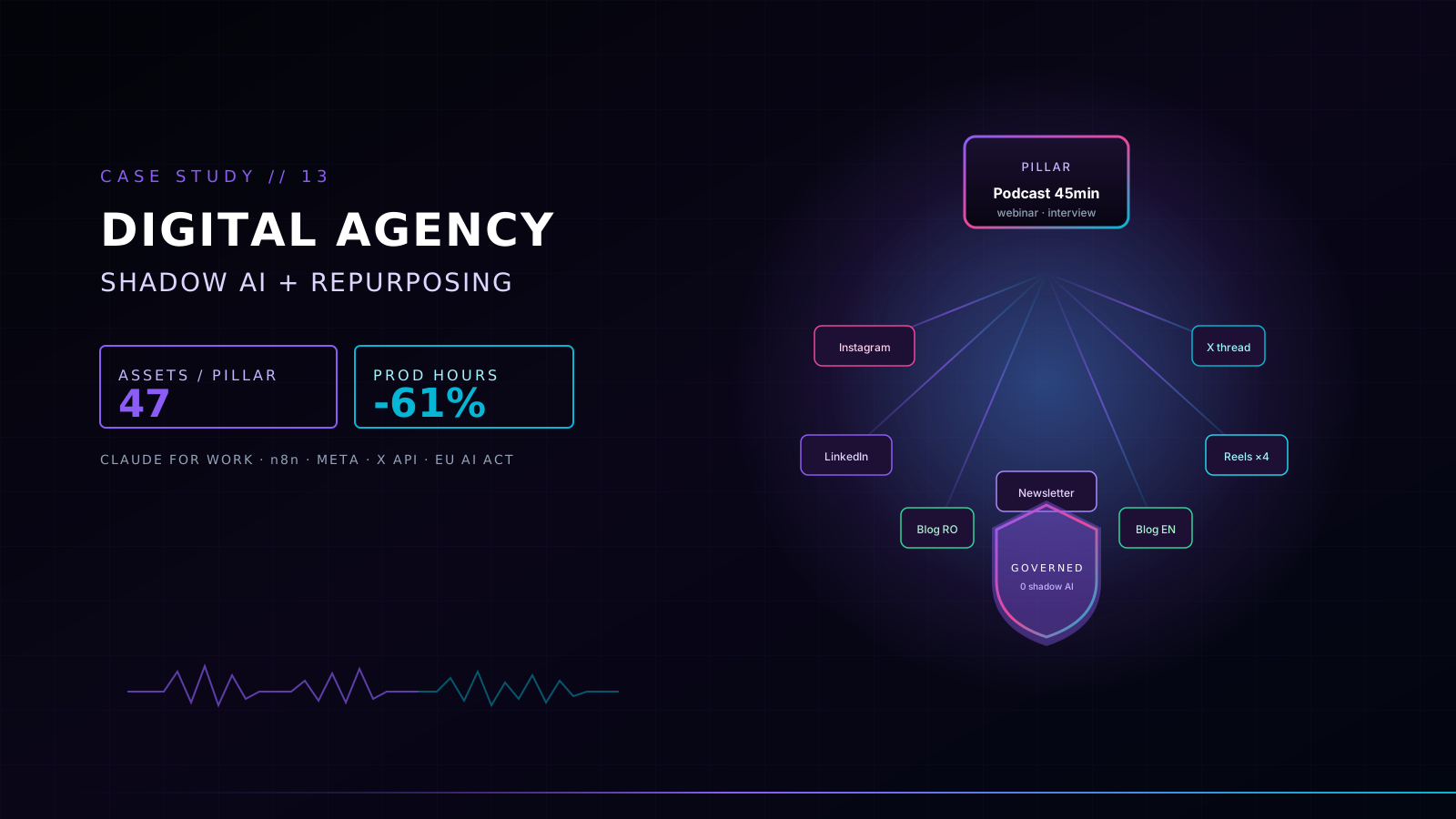
- One-to-many repurposing pipeline: a single pillar asset (podcast, webinar, founder interview, case-study call) ingested via Riverside/Zoom → transcribed → structured into chapters, quotes, stats, and CTAs → auto-generated draft buckets for blog (RO + EN), Instagram carousel (7–10 slides with platform-native hooks), X thread (8–12 posts with line-break rules), LinkedIn long-form, newsletter section, 4× vertical Shorts/Reels cuts, and 6 quote cards for Stories
- Platform-native rewrite layer — not cross-posting: the same insight ships as a story-led LinkedIn post, a punchy X thread with a contrarian hook, and an Instagram carousel that earns the save on slide 3; a style matrix per client encodes forbidden phrases, emoji density, and RO/EN tone
- Instagram + X scheduling with engagement windows: assets queue through Meta Business Suite and the X API, but the pipeline blocks publish until a human marks the 'first-hour engagement' slot on the calendar — automation handles production, not the relationship
- Client approval portal: every weekly batch lands in a Notion/Slack review with side-by-side RO/EN previews; one-click approve, comment, or send back — average approval cycle dropped from 3.2 days to 9 hours
- DM and comment playbook library reused from the agency's beauty-studio builds: templated escalation paths for price, booking, and complaint intents, deployable per client in under a day when a retainer adds social community management
- AI inventory register for vendor questionnaires: living document listing models in use, data categories processed, human oversight points, and retention — pulled the payments startup and clinic group renewals over the line in July
- Margin dashboard per client: pillar hours in, derivative count out, approval cycles, and platform reach delta — made it obvious which retainers should move to a higher repurposing tier (+€1,800/month) and which clients were over-producing for their ICP
The results after one quarter
By the end of Q3 2026 the pipeline was processing 6–8 pillar assets per week across the roster and shipping an average of 47 platform-native derivatives from each — up from 11 manually produced pieces at roughly triple the labor. Content production hours per client fell 61%. The team that used to spend Sunday night reformatting carousels was approving batches Monday morning and spending the reclaimed time on strategy and upsells.
Shadow AI went to zero — not because people stopped wanting shortcuts, but because the sanctioned stack was genuinely faster for the top three workflows (repurpose, translate RO↔EN, first-draft ad copy). The fintech client stayed; the compliance officer got the inventory register and a quarterly review slot. Two other clients cited 'documented AI governance' as the reason they picked this agency over a cheaper Cluj shop in competitive pitches.
Instagram and X metrics moved when the content stopped looking copied. For a sample cohort of nine clients, average carousel save rate on Instagram rose 44% quarter over quarter, and X thread impressions rose 31% against the same topics posted as single-link posts in Q1. The agency productized a 'Pillar → 40' repurposing retainer at €2,400–€4,100/month depending on volume and brought on 11 new clients with the same 22-person team — no copywriter hires, two strategists redeployed from formatting work to client discovery.
The line the founder repeats on podcasts now: 'Our moat isn't that we use AI. It's that we can prove where client data went, who approved what, and why your Instagram carousel doesn't read like your X thread got lost in translation.'
What we'd do differently
We launched the repurposing pipeline before the governance story was legible to clients — and half the team treated it as a production tool, not a compliance one. We should have led the internal rollout with the fintech near-miss and the EU AI Act dates, then shown the speed win. Adoption clicked when people understood they weren't being surveilled; they were being protected from the Sunday-night paste that ends a contract.
The first version of the platform-native rewrite layer was too clever — it tried to make every X thread sound 'viral' and clients pushed back that it didn't sound like them. We added a per-client 'voice sample' upload (10 approved posts) and a hard rule: if the creative director scores a draft below 4/5 on brand fit, the model prompt gets retrained on that feedback, not the strategist's personal taste.
We'd also start the Instagram DM playbook library on day one for every retainer that touches social, not only when a client complains about unanswered comments. Three clients signed community-management upsells in Q3 that we'd have caught in Q2 if the inbox pain had been part of the standard discovery call.
"We almost lost a client because someone pasted a dashboard into the wrong tab. Now we ship more content than agencies twice our size — and I can actually answer when procurement asks where the AI is."
— Founder & CEO, digital marketing agency