The problem
Romanian DTC in 2026 looks nothing like the playbook from 2022. Our client — two founders, a Bucharest formulation lab, and a Shopify store shipping nationwide — had built a genuine clean-beauty following on Instagram: niacinamide serums, barrier-repair creams, zero parabens, the whole shelf. By spring 2026 they were doing roughly €140K a month in revenue, which sounds like a win until you realize it was being held together with duct tape, twelve SaaS subscriptions that didn't talk to each other, and a founder who hadn't answered a personal DM in three weeks because she was packing orders until midnight.
The first crack was tool sprawl — the failure pattern that broke more small-business automation projects in 2026 than bad AI ever did. Buffer for scheduling. Manychat for DMs, but only partially wired. A separate Klaviyo for email. Shopify for orders. A Google Sheet for inventory that was always six hours stale. SmartBill for e-Factura, manually triggered. Notion for content planning. Canva for assets. A freelancer on Upwork for captions. Meta Ads Manager. TikTok Creative Center bookmarked but never integrated. Twelve tools, €840 a month, and every order still required someone to copy a name from Instagram into Shopify and then into SmartBill. When a Zap broke on a Tuesday — and one always did — the founders found out from an angry customer, not from an alert.
The second crack was the DM backlog. Instagram had become the brand's primary sales counter, not its marketing brochure. Roughly 58% of new orders in Q1 2026 originated from a DM conversation — someone asking 'will this work on rosacea?', 'do you ship to Cluj same week?', 'can I combine the serum with the SPF?' — and the median reply time had drifted from 2 hours in 2024 to 14 hours by May 2026. Four hundred unread messages every Monday morning. Competitors with faster replies — or a bot that at least acknowledged the question — were winning the sale while our client's messages sat on read. The founders knew the personal touch mattered; they just couldn't scale the personal touch across 120 DMs a day.
The third crack was social search — the trend every Instagram and TikTok strategist was shouting about on X in early 2026, and the one most Romanian brands were still ignoring. Sprout Social's 2025 index showed a third of consumers now start product discovery on social platforms. Our client's Google Analytics told the same story: branded search was flat, but 'ser cu niacinamida piele uscată' was finding them through Instagram Reels and TikTok search because a creator had stitched their routine video. The content was good. The metadata was wrong — no keyword captions, no on-screen text, no pinned comments with product links, no systematic reposting of the UGC that was already selling the product for free.
Then January 2026 brought the compliance layer. e-Factura B2C — mandatory for every consumer transaction — meant every Shopify order needed a structured invoice in SPV ANAF within five working days. The brand was issuing them, eventually, but the workflow was: finish packing, open SmartBill, retype the customer data, submit, paste the PDF into an email. On a 200-order week that was six hours of work that generated zero revenue and carried a 15% fine risk if someone forgot a batch. The founders' words at kickoff: 'we're either a skincare company or an invoice company — we can't keep being both.'
What we built
We didn't add a thirteenth tool. We burned the stack down to four connected systems — Shopify as the system of record, n8n as the orchestration layer, an AI DM concierge on Instagram and Messenger, and SmartBill wired for automatic e-Factura — and rebuilt the workflows that actually moved revenue. The rule we set with the founders on day one: AI handles the typing and the routing; humans handle the brand voice approval, the formulation questions that need a chemist, and the angry orders. Everything else is automation.
Two constraints shaped the build. First: the DM agent never pretends to be the founder — it identifies itself as the brand's assistant, recommends from an approved product matrix, and escalates anything involving a skin reaction, a refund dispute, or a wholesale inquiry to a human within 60 seconds. Second: no post goes live without a founder tap on the approval queue — AI drafts, humans sign. That hybrid model is exactly what the 2026 Instagram playbook demands: automate the typing, keep the trust.
- Stack consolidation: retired seven overlapping subscriptions (duplicate schedulers, unused analytics, a CRM nobody opened), rewired the remaining four through n8n, and cut monthly SaaS spend from €840 to €310 while closing more loops — the anti-pattern of 'buying tools before naming the job each one does'
- Social-search SEO engine: keyword research mapped to Romanian skincare search terms on Instagram and TikTok ('ser niacinamida', 'cremă barieră piele sensibilă', 'SPF fără albire'), fed into an AI content brief generator that outputs Reels scripts with mandatory on-screen text, keyword captions, alt text, and pinned-comment product links — organic social-search traffic up 4.2× in 90 days
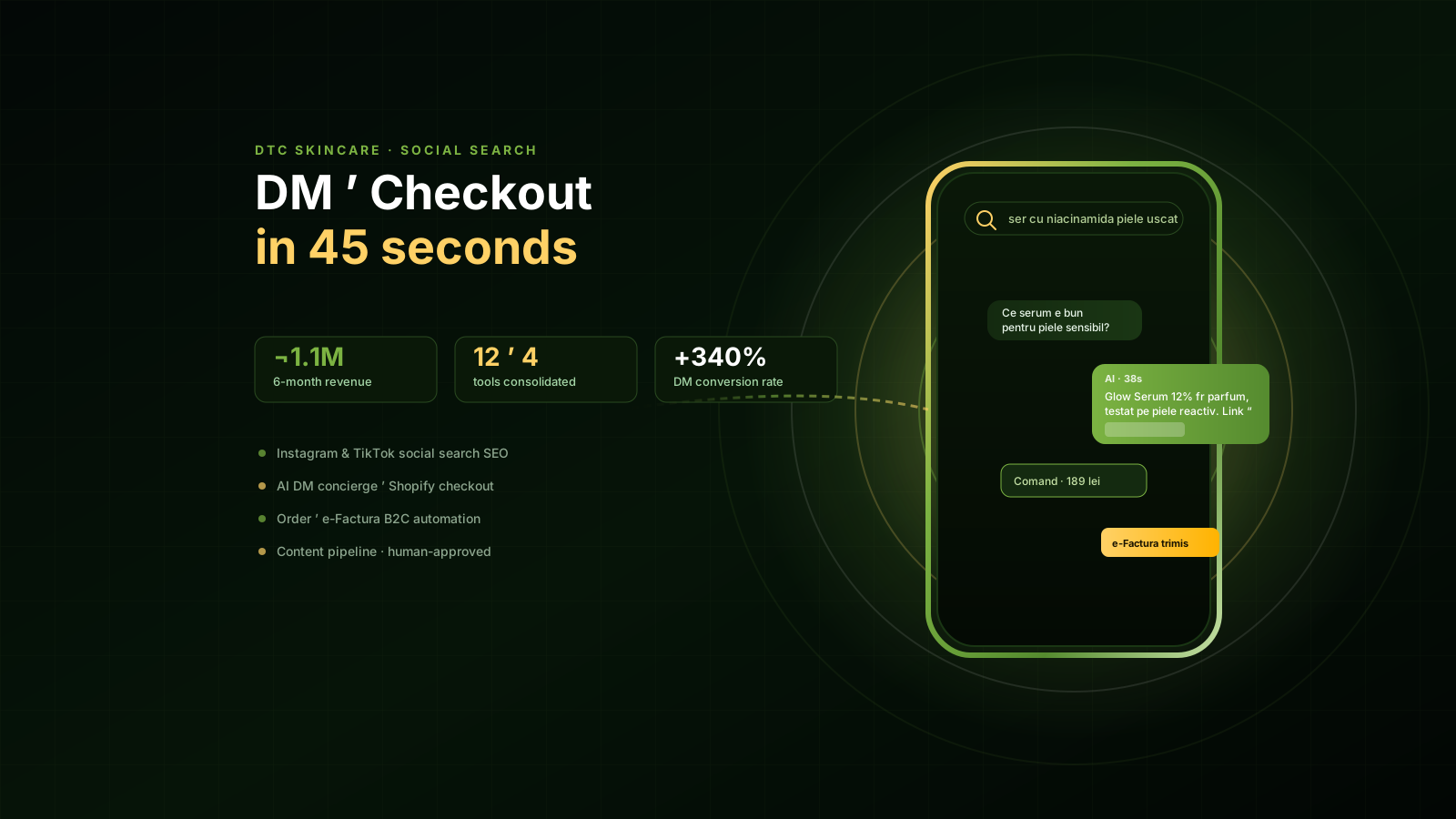
- 24/7 AI DM concierge on Instagram, Messenger, and WhatsApp: answers product-fit questions from an approved ingredient-and-concern matrix, checks real-time Shopify inventory, sends personalized checkout links with pre-applied bundle discounts, and logs every conversation to HubSpot — median reply 45 seconds, 24/7; 71% of DM threads now close without a founder opening the app
- Human-in-the-loop escalation: skin-reaction reports, refund requests over 300 lei, influencer collab inquiries, and any message containing 'lawyer' or 'ANPC' route to the founders' shared inbox with full thread context and a suggested reply draft — zero autoresponder on sensitive threads
- Content pipeline with approval gate: AI drafts 5 Reels captions + 3 carousel posts weekly from the social-search calendar; founders approve or edit in a Slack queue; approved posts auto-schedule through Meta Business Suite and TikTok — content output doubled without doubling screen time
- UGC harvest loop: every post mentioning the brand (tagged or untagged, found via social listening) enters a rights-request workflow — auto-DM asking permission, on approval the clip enters a repurposing queue with product links and keyword overlays — 34% of Q2 ad creative came from customer videos the brand didn't pay to produce
- Shopify → SmartBill → SPV e-Factura B2C pipeline: every paid order generates a draft e-Factura, submits to ANAF within 24 hours, and emails the PDF to the customer automatically — 100% B2C compliant, six packing-hours/week returned to the founders
- Abandoned-DM recovery: conversations where the customer asked a product question but didn't click checkout within 48 hours get a single follow-up with a size guide, a review snippet, and a 48-hour discount code — recovered €47K in otherwise-dead DM threads in the first quarter
The results after six months
By the end of the six-month window the brand had crossed €1.1M in revenue — up from a €680K run rate at kickoff — with the same two founders and one part-time packer. The DM concierge handled 9,200 conversations a month with a median reply of 45 seconds. Instagram DM-to-order conversion rate climbed 340% versus the pre-automation baseline, and the Monday-morning backlog went from 400 messages to zero — not because messages stopped arriving, but because most of them closed before the founders woke up.
Social search became a real channel, not an accident. Reels optimized for Romanian skincare keywords started appearing in Instagram and TikTok search results within three weeks, and by month four organic social-search sessions were driving 38% of new-customer revenue — more than Meta Ads and more than Google branded search combined. The UGC loop fed itself: customers who discovered the brand through search, bought through DM, and then posted their own routines created the next wave of searchable content.
The operational win was quieter but sharper. Admin time dropped from 28 hours a week to six — the founders reclaimed three and a half evenings and stopped hiring the virtual assistant they'd been about to onboard. SaaS spend fell €530 a month. e-Factura compliance hit 100% with zero manual SmartBill sessions. And when a competitor copied their packaging in April, the brand responded with a Reels series on formulation transparency that trended in skincare search for two weeks — posted from the approval queue in forty minutes, not forty hours.
The number the founders quote to other DTC operators: they didn't get faster at DMs by typing faster. They stopped treating Instagram as a marketing channel and started treating it as a storefront — with search discovery out front, an AI clerk inside, and Shopify plus ANAF wired behind the counter.
What we'd do differently
We launched the DM agent with slightly too much personality — witty, emoji-heavy, very 'founder voice' — because the founders wanted it to feel personal. It worked until a customer with a genuine allergic reaction got three joke-adjacent replies before escalation. We rewrote the tone guide: warm and clear, never cute, and any mention of irritation, burning, or rash ends the automation immediately with 'a founder will reply within 10 minutes.' In DTC skincare, the escalation speed matters more than the brand voice.
We underestimated how fast TikTok search behaviour diverges from Instagram. The same keyword caption that ranked on Instagram Reels needed different on-screen text density and a different hook structure on TikTok — we lost three weeks assuming cross-posting was enough. We split the social-search calendar into platform-specific briefs and the ranking recovered within ten days. The lesson: social search is not one algorithm; it's two, and they read metadata differently.
The line we'd underline for any DTC brand staring at tool sprawl in 2026: consolidate before you automate. The founders had tried to wire Manychat to Shopify through a chain of three Zaps before we arrived — brittle, silent when it broke, and expensive. One n8n instance with four solid integrations beat twelve SaaS logos on a slide deck. Automate the chaos and you just get faster chaos. Stabilize the stack, then let AI run the counter.
"We had twelve tools and still copied every order by hand. Now we have four, the DMs answer themselves, and I pack boxes instead of living inside Instagram. Social search did more for us in six months than two years of Facebook Ads."
— Co-founder, DTC skincare brand