The problem
By mid-2026, every Romanian D2C founder had the same confession on X: they weren't short on automation tools — they were drowning in them. Our client, a home & lifestyle brand that grew from a Cluj showroom into a national Shopify store selling sofas, pendant lights, and linen sets, had subscribed to the full buffet. ManyChat for Instagram comment triggers. Zapier for 'when someone fills the form, add them to Klaviyo.' A separate inbox app for Facebook Messenger. Buffer for scheduling. A Shopify flow for abandoned carts. A freelancer-built Google Apps Script for e-Factura that broke quietly every third week. And a shared Gmail label called 'URGENT DMs' that three people checked when they remembered.
Seven tools. Zero system of record. The pattern that kept showing up in X threads about small-business automation in 2026 — tool sprawl, integration brittleness, automating chaos — wasn't an abstract consulting slide for this team. It was Tuesday.
The first leak was speed. Instagram had become the brand's top discovery channel: Reels of living-room makeovers drove comment floods of 'price?' and 'shipping to Constanța?' The ManyChat flow could reply to comments with a generic 'check our bio link,' but anything that needed a real answer — dimensions, fabric swatches, delivery windows, whether the oak finish matched the photos — landed in a DM queue nobody owned after 18:00. Median time from DM to first human reply was 11 hours. Industry data and the brand's own funnel math said the same thing everyone on X was repeating: slow follow-up costs 40–60% of potential revenue. A customer who asks about a 2,400-lei sofa at 21:30 doesn't wait until tomorrow's office hours. She buys from the brand that answers while she's still on the couch.
X was the second leak, and almost nobody in Romanian e-commerce was talking about it yet — which was exactly why it hurt. Product designers, interior bloggers, and the 'where did you get that lamp?' crowd had moved their discovery questions to X posts and replies. The brand's account had 14,000 followers and a graveyard of unanswered '@' mentions. There was no automation wired to X at all; the founder checked it on Sunday nights and felt guilty.
The third leak was what X calls 'integration brittleness.' In February 2026, Meta updated the Instagram Messaging API permissions. Three Zaps died overnight. The comment-to-DM flow started sending people to a 404. For nine days the team sold through Instagram manually while arguing about whose Zapier seat had admin access. A customer who got a broken link twice doesn't come back — she screenshots it to her group chat with the caption 'unserious brand.'
Then January's e-Factura B2C mandate turned the back office into a fourth clock. Every Shopify order to a Romanian consumer now needed a structured invoice in SPV ANAF within five working days. The Apps Script workaround generated XML from a CSV export that someone ran on Fridays. One busy launch week, 340 orders stacked up unaudited. The accountant's message was blunt: 'either we fix this pipeline or we stop selling B2C until someone can type invoices by hand.'
The founder's summary at our kickoff, paraphrasing a post she'd seen go viral on X that week: 'we don't need another AI tool. We need one brain that actually knows our catalog, our shipping rules, and our customers — and that doesn't break when Zuckerberg changes a checkbox.'
What we built
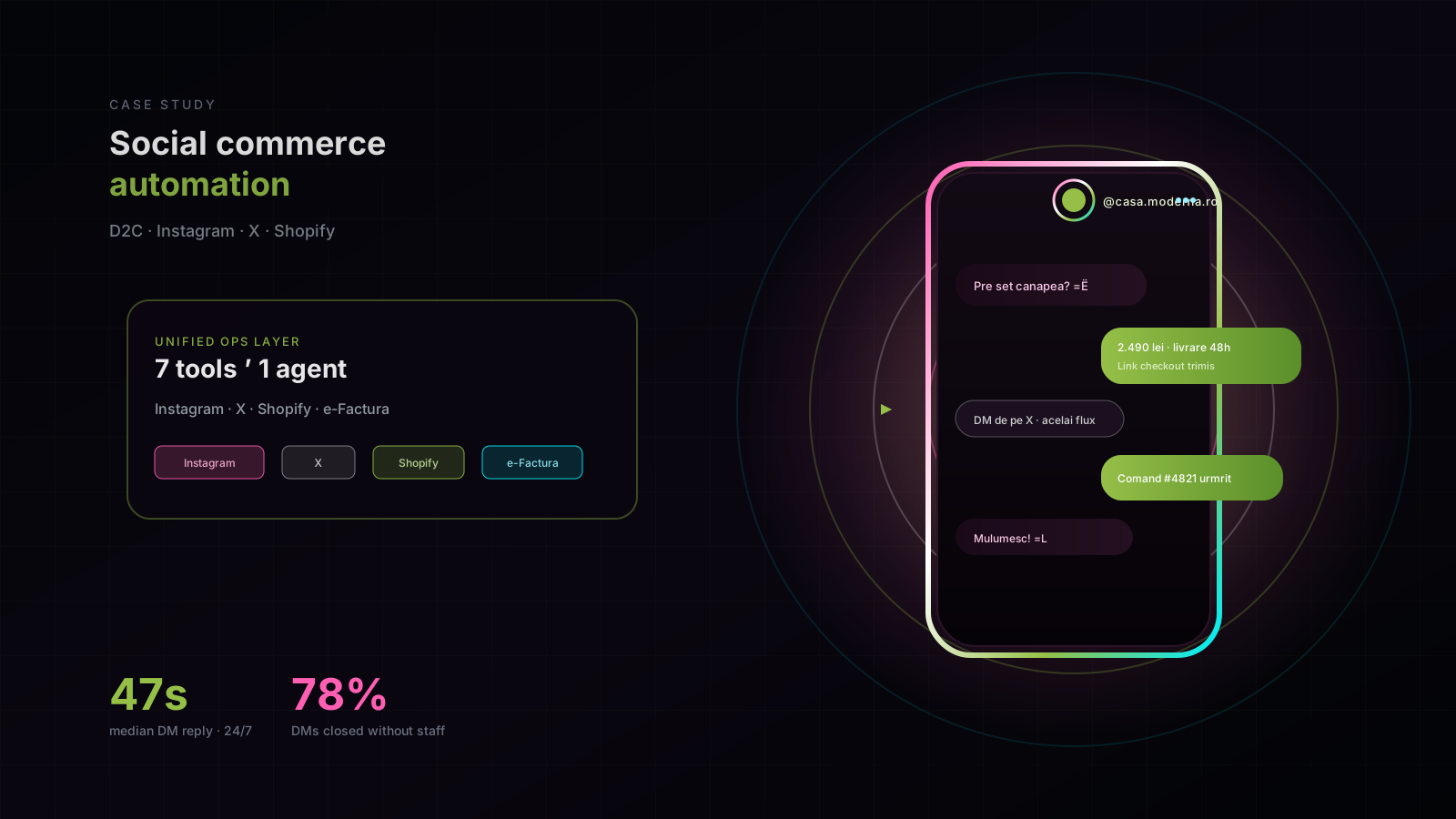
We didn't add an eighth tool. We ripped out the seven that didn't share a database and replaced them with one AI ops layer on top of Shopify as the system of record — with n8n as the orchestration spine, not a pile of one-off Zaps. Three specialized agents handle conversation, commerce, and compliance. They share customer context, order history, and catalog data. When Meta changes an API field, we fix one connector, not seven.
The rules we set with the founder on day one, aligned with what the EU AI Act and every sensible X thread on AI governance were saying in 2026: the agents can answer, quote, recommend, and prepare invoices — but a human owns every refund, every discount above the published floor, every complaint that mentions 'ANPC,' and every e-Factura line ANAF will read. Automate the conversation and the paperwork, not the judgment call.
- Unified social inbox across Instagram DMs, Instagram comment triggers, Messenger, and X DMs/replies: one agent reads every channel, knows the customer's prior orders from Shopify, answers catalog questions ('is the 220cm sofa too big for a 3.2m wall?') with real dimensions and stock status, and sends a personalized checkout link in under 60 seconds — 78% of conversations now close without a human touching the keyboard
- Comment-to-DM engine rebuilt on the Graph API with a drift monitor: when someone comments 'preț' or 'link' on a Reel, the agent opens a DM with the exact SKU from the post metadata, not a generic bio link — comment-to-cart conversion rose 3.4× versus the old ManyChat flow
- X reply co-pilot: monitors brand mentions and product-question threads, drafts on-brand replies with UTM-tagged links, and escalates anything about a delayed shipment or damaged item to a human within 90 seconds — the channel went from 'checked on Sundays' to 340 qualified conversations a month
- Order concierge wired to Shopify Admin API: 'where is my order?' pulls live tracking from the courier integration, 'can I change the delivery address?' checks cut-off rules and updates the fulfillment hold, 'I want to return the lamp' starts the return flow and queues a human approval — cutting 'where is my package?' tickets by 64%
- Lead follow-up sequencer: any DM or X conversation that doesn't convert in-session gets a timed follow-up at 2 hours, 24 hours, and 72 hours with a different angle (fabric swatch photos, financing options, showroom appointment) — recovered 22% of conversations that would previously have died in silence
- e-Factura B2C engine: every paid Shopify order generates a draft e-Factura reconciled against the order total, customer CNP collected at checkout, and XML queued for the accountant's one-tap submit to SPV ANAF — 100% B2C compliant since February 2026, zero Friday CSV rituals
- Ops dashboard replacing seven browser tabs: one screen shows DM queue depth, response times, social-attributed revenue, integration health, and e-Factura status — when a connector drifts, it pages the team before a customer notices
The results after six months
By June 2026 the brand had retired six paid subscriptions and one freelancer retainer, replaced them with a single ops layer, and kept the same six-person team while social-attributed Shopify revenue hit €2.8M in six months — up from €1.6M in the prior half-year on the broken stack. Median first response on Instagram and X fell from 11 hours to 47 seconds, 24/7. Seventy-eight percent of DMs now resolve without staff, and the two people who used to spend their mornings copying order numbers between apps were redeployed to content and showroom events — the work that actually grows a lifestyle brand.
The comment-to-DM rebuild was the quiet multiplier. Reels had always driven views; now they drove carts. Matching the SKU in the post metadata to the checkout link in the DM sounds obvious, but it's exactly the kind of thing that breaks when your automation is seven tools held together with Zaps. Conversion from comment trigger to paid order rose 3.4× in the first quarter after launch.
X became a real channel, not a guilt trip. Three hundred forty qualified conversations a month, a growing share of interior-designer referrals, and zero viral screenshots of broken links — because the reply agent and the Shopify connector share one catalog brain.
Integration brittleness stopped being a fire drill. When Meta pushed another Messaging API change in April, the drift monitor flagged it in six hours and one connector patch restored service before the Monday DM rush. The founder posted about it on X — 'we used to lose a week; we lost an afternoon' — and three other Romanian D2C brands reached out the same week.
Compliance closed the loop. Every B2C order had an e-Factura draft waiting in SPV the same day. The accountant's Friday CSV panic became a ten-minute review. One less thing to lie awake about — and one more reason the ops layer paid for itself before the social-commerce numbers even landed.
What we'd do differently
We started with one mega-prompt handling Instagram, X, and order lookups together. It worked until it didn't — the X audience asks in a different register than Instagram ('spec sheet?' vs. 'ce material e?'), and the model occasionally mixed up two similar pendant lamps with a €180 price gap. We split into three specialized agents with a shared customer record, which is the multi-agent pattern everyone on X was experimenting with in 2026. Slightly more infrastructure, far fewer 'sorry, wrong product' moments.
We underestimated AI review overhead on the first launch. The agent drafted fine; humans spent an hour a day fixing tone on escalated threads anyway. We added a weekly 'voice audit' of 50 random conversations and a hard rule: anything mentioning price above 5,000 lei or custom upholstery gets a human preview before send. Review time dropped from 7 hours a week to 90 minutes without hurting conversion.
The line we'd underline for any D2C brand reading the 2026 automation discourse on X or Instagram: start with your biggest revenue leak, not your trendiest tool. For this team it was DM response time, not email flows or back-office reporting. Document the workflow once, put Shopify (or your real system of record) in the center, and automate outward from there. Seven tools that don't share a database aren't automation — they're seven places for revenue to leak.
"We had seven tools and still answered DMs like it was 2019. Now one system knows our catalog, our shipping rules, and every order — and when Meta breaks something, we fix one wire, not seven. Instagram and X finally sell like channels, not chores."
— Founder & CEO, home & lifestyle D2C brand