The problem
September is when Romanian heating work stops being theoretical. Homeowners who ignored the boiler all summer start searching 'pompă de căldură Cluj' the week school starts, Instagram Reels of before/after plant rooms suddenly get reach, and every competitor with a van and a Meta ads budget floods the same feed. Our client — a 22-person HVAC group running heat-pump, hybrid, air-conditioning, and boiler jobs out of Cluj-Napoca with crews in Oradea and Târgu Mureș — had turned Instagram into their #1 lead source by mid-2026. The problem was not demand. It was what happened in the 40 minutes after someone commented 'preț?' under a Reel.
The old stack was a receptionist, three shared WhatsApp Business numbers, and a lot of typing. A typical booked survey burned 9–14 free-form messages: square metres, year of build, radiator vs underfloor, gas meter size, photos of the plant room, 'can you come Saturday', 'how much roughly', 'my brother-in-law got a quote for X'. Median first reply during office hours was fine. After 18:00 and on Sundays — when Reels actually peaked — the median sat past two hours. Speed-to-lead studies the founder had bookmarked said five minutes; the inbox said Tuesday.
Then Meta moved the goalposts under their feet. On 1 August 2026 Meta Business Agent replies started billing per token — roughly four to five US cents per chatty turn if you let Meta's own agent ramble. On 1 July Romania had already been pulled onto a higher utility and authentication rate card. On 1 September 2026 Meta published the October rates: from 1 October every service message (human or third-party AI free-form reply inside the 24-hour window) and every in-window utility template becomes chargeable at that utility rate, with a free monthly tier of only 1,000 service messages per business phone number, no rollover, no volume discount on service. Payment method must sit on the WABA by 30 September or Meta stops delivering service messages entirely when charging begins. The founder's spreadsheet — built on the comforting fiction that inbound WhatsApp was free forever — showed a five-figure lei surprise for October if they kept chatting the same way through the autumn peak.
Governance was the quieter risk. The team had flirted with a long-prompt 'sales AI' that happily invented heat-pump seasonal COP numbers, implied ANRE paperwork was 'already handled', and once quoted a hybrid system 18% under cost because a homeowner uploaded a blurry photo of someone else's invoice. In a year when LinkedIn and X were full of agentic-AI rollback stories — enterprises yanking agents from production over unscoped autonomy — the last thing a regulated installer needed was a bot that sounded sure. EU AI Act Article 50 transparency obligations had been live since 2 August 2026: the first message has to say it is AI, in plain language, not buried in a footer. They needed fewer messages, faster intake, honest disclosure, and a hard stop before money or technical claims left the chat.
What we built
We did not buy Meta Business Agent. Token-billed native agents are the wrong tool when your October problem is message count and your compliance problem is overconfident technical claims. We built a short, scoped custom agent on WhatsApp Business API + Instagram Messaging, with WhatsApp Flows as the intake backbone, and we treated every free-form reply as a cost that had to earn its existence before 1 October.
Two rules with the technical director on day one. First: the AI never locks a price and never diagnoses a fault. It can collect structured inputs, book a site survey, and share catalogue ranges labelled as non-binding — but any number that could be read as a quote routes to a human estimator. Second: every conversation opens with an Article 50 disclosure in the first sentence ('You're chatting with an automated assistant from [brand]; a technician reviews every offer'). Both rules also keep the system on the right side of the governance failure mode that has been trending across X and LinkedIn all summer: autonomy without a human gate.
- Instagram Reel comment-to-DM bridge in week one of autumn creative: keyword and intent triggers ('preț', 'pompă', 'montaj', 'ofertă') open a DM in under 30 seconds with the Art. 50 line and a single CTA into WhatsApp Flows — so viral reach stops dying in the comments
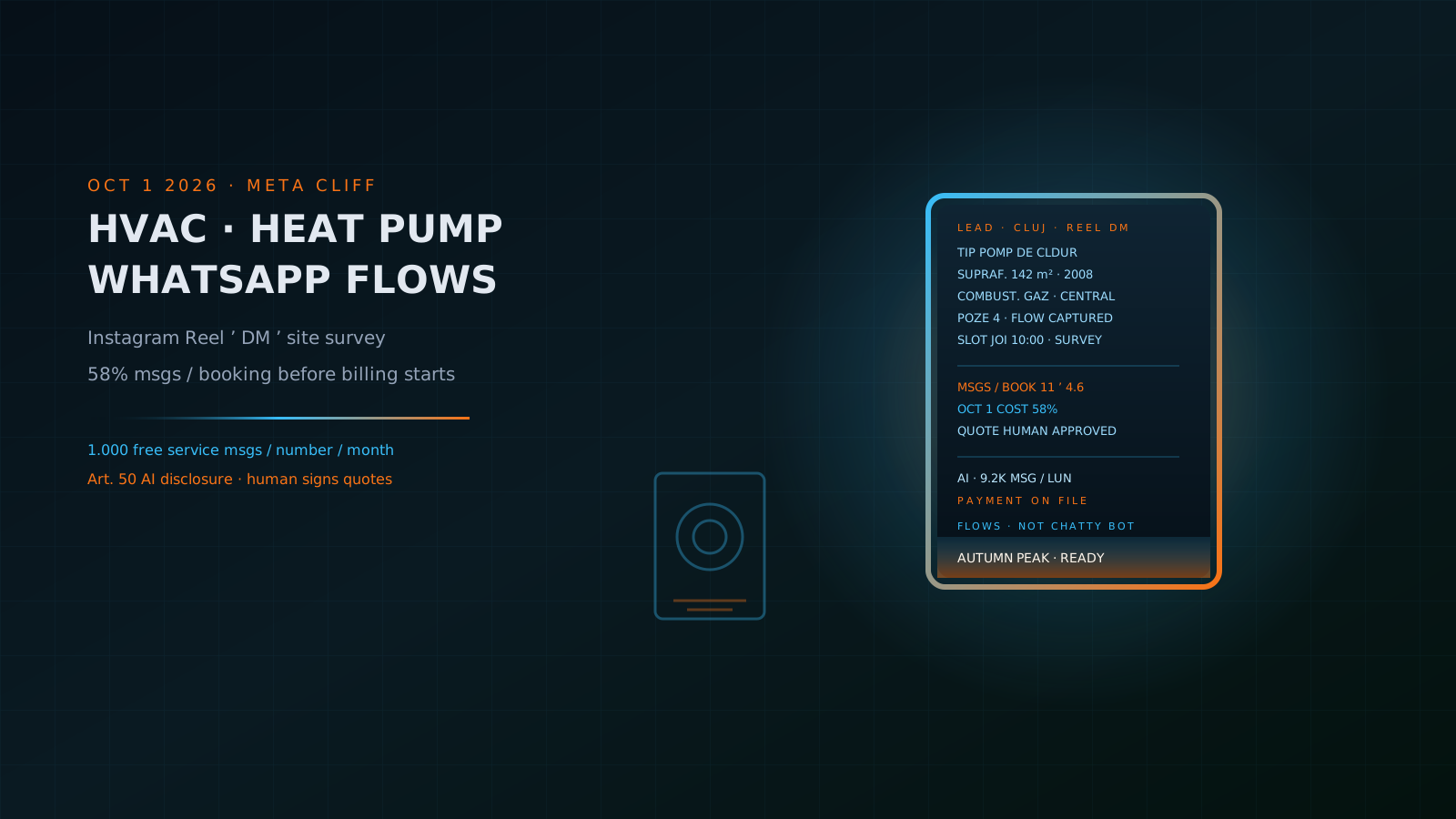
- WhatsApp Flows intake instead of chat tennis: square metres, construction year, heating distribution (radiators / underfloor / mixed), current fuel (gas / electric / district), plant-room photos, preferred city (Cluj / Oradea / Târgu Mureș), and survey window — one structured session replaces 6–8 free-form turns
- Short custom reply agent (not Meta Business Agent): answers catalogue FAQs from a vetted knowledge base, refuses COP/SCOPs inventing and 'you'll save X lei/year' claims, and escalates anything that smells like a fault diagnosis ('boiler error E2', gas smell, no heat) to a human within one turn
- Message-budget co-pilot ahead of 1 October: live counter per phone number against the 1,000 free service-message tier, preference for Flow replies and approved utility templates over chatty text, and an alert at 70% of the monthly free tier so ops can open a second number or throttle marketing spend
- Estimator hand-off pack: every booked survey lands in the CRM with Flow answers, photo set, drive-time slot, and a draft non-binding range for the human to edit — technicians stop rebuilding the brief from a 40-message chat scroll
- Payment-method and WABA hygiene checklist shipped by mid-September: billing on file before the 30 September cutoff, template review for utility confirmations (survey booked, technician en route, job closed), and a kill-switch that pauses non-essential outbound if a number approaches the free-tier ceiling in October
- ANRE / paperwork co-pilot for heat-pump jobs that need distribution-operator or documentation follow-ups: the agent chases missing homeowner docs on a drip, never claims authorisation is 'done', and flags incomplete dossiers before the crew rolls out
- e-Factura + deposit workflow after a human-signed offer: deposit link, structured invoice queue, and a utility-template status path that stays cheaper and cleaner than free-form 'did you pay?' nagging once October rates apply
The results after six weeks
We went live in the second half of July and measured through the first September surge — exactly the window where Meta published the October card and every Romanian API user started doing the same napkin maths. Monthly Instagram + WhatsApp volume hit 9,200 conversations without adding office staff. Median first reply after hours dropped under a minute. The metric that mattered for 1 October was denser: average WhatsApp messages per booked site survey fell from 11.0 to 4.6 (−58%), mostly because Flows ate the qualification turns that used to be typed by hand.
Conversion followed the quieter inbox. Survey-to-signed-contract rose 31% versus the same six-week window in 2025, which the founder attributes less to 'AI magic' and more to technicians arriving with a complete brief and homeowners not going cold waiting for a Sunday-night reply. No-show surveys fell 22% after utility-template reminders replaced ad-hoc pings.
On cost: a projection against the published October service rates puts two of the three business numbers under the 1,000 free service-message tier in a typical October week if Flows stay the default; the Cluj metro number still overshoots on peak Reel days, which is why the budget co-pilot and a fourth number were approved before 30 September. They never enabled Meta Business Agent in production — after a one-week shadow test the token burn on long technical answers was simply the wrong cost shape for an installer that needs short, gated replies.
Compliance held. Every thread opened with the Article 50 line. Zero customer complaints about undisclosed automation in the pilot window. The estimator team rejected 14 AI-drafted ranges in the first month for being too aggressive on hybrid sizing — exactly the failure mode we wanted a human to catch — and the knowledge base was tightened the same afternoon. Autumn demand is still a grind. It is no longer a typing contest with a ticking Meta invoice attached.
What we'd do differently
We under-invested in the Reel comment-to-DM bridge in week one of the first autumn creative flight. Organic comments sat visible while the DM agent waited for people who already knew to write first — and Romanian Instagram users often never take that step. Wire the comment keyword bridge before you boost the Reel, not after you notice a beautiful comment thread with zero surveys behind it.
We let the FAQ agent answer 'how much for 120 m²' with a wide catalogue band too early. Homeowners read bands as quotes. We now refuse square-metre pricing in chat entirely: Flow → survey → human range. If you remember one HVAC-specific rule for 2026, make it that — especially while X and LinkedIn keep circulating agent rollback stories about models that sounded commercially sure.
We almost 'saved time' by turning on Meta Business Agent for after-hours overflow. The token economics and the long, confident answers fought both the October message cliff and the Article 50 / no-diagnosis rules. Short custom agents plus Flows beat a chatty platform agent when your KPI is billable messages per job, not words generated. Add the WABA payment method by 30 September, count messages like you count diesel, and let a human sign every number that touches a contract.
"October 1 was going to turn our Instagram success into a WhatsApp tax. Flows cut the chatter, the bot discloses itself and never signs a quote, and the crew finally shows up to surveys already knowing the plant room. That is the automation I will pay for — not a more talkative agent."
— Managing partner, HVAC & heat-pump installer