The problem
By mid-2026 the brand's biggest sales channel was not the Shopify homepage. It was a Reel that went sideways at 22:40 on a Tuesday — a 19-second clip of a handmade mug being glazed — followed by a flood of Instagram DMs that looked identical and arrived for six hours straight: 'Mai e în stoc?', 'Faceți ramburs?', 'Cât e livrarea în Cluj?', 'Aveți și în alb?'. Eight people, a 180 m² warehouse in Bucharest's outskirts, and a founder who still packed the first fifty orders of a drop herself. The product sold. The inbox did not scale.
Cash on delivery was the second leak. Roughly 62% of first-time Instagram buyers still preferred ramburs — pay the courier when the box arrives — and the refusal rate on those parcels had climbed to 28% by Q2 2026. Every refused AWB meant outbound shipping, inbound return, restocking, and a FanCourier invoice the margin could not absorb on a 189 RON ceramic set. The warehouse team could smell a risky COD order from the chat ('send three, I'll see which I keep'), but by the time a human read the thread the label was already printed.
Then Meta moved the goalposts. On 1 July 2026 the Meta Business Agent Platform opened globally — an autonomous AI that answers product questions, pulls from a catalog, books, and closes inside WhatsApp, Instagram, and Messenger. The brand turned it on during the free test window. For three weeks it felt like magic: Reels comments converted into answered DMs overnight, and the founder finally slept past 07:00. The fine print arrived with the July documentation update. Effective 1 August 2026, Meta Business Agent messages bill at a global $2.00 per million tokens — roughly 4–5 US cents per typical reply, more when the agent digs through a catalog and walks a buyer through a multi-turn sale. Effective 1 October 2026, ordinary service messages inside the 24-hour customer-service window — the free replies the brand had relied on since late 2024 — become billable again at per-message market rates.
The founder ran the napkin math on a good month. Thirty thousand agent-handled messages at ~5¢ is about $1,500 — fine. A single viral Reel that triples volume for ten days, with longer multi-turn chats, and the invoice becomes something you discover at month-end, not something you budget on Monday. Token shock is the name the industry gave it; the warehouse called it 'paying Meta extra on the days we already win.' On top of that, Meta's own agent could not see the brand's internal COD blacklist, could not refuse to print an AWB for a known serial refuser, and would cheerfully quote a mug that the WMS had marked reserved for a pop-up. And every cash sale still needed an e-Factura B2C into SPV ANAF within five working days — another queue the free agent did not own.
The decision in the last week of July was binary: ride Meta's meter into August and hope the viral days stay polite, or own the conversation layer with a governed third-party agent — billed as a service message on Meta's pipes, with AI cost on a flat predictable plan — that knew the warehouse, the COD rules, and the e-Factura queue. They chose ownership.
What we built
We did not replace Shopify, the WMS, or FanCourier. We put a governed AI commerce agent between Instagram DMs, WhatsApp Business, the catalog, and the warehouse — with hard rules about money, stock, and anything that looks like a refund. The agent is a third-party AI on Meta's messaging pipes, so from Meta's pricing model it is a service message, not a Meta Business Agent message: no per-token meter on 1 August, and a cost curve the finance lead can put in a spreadsheet before the month starts.
Two rules with the founder on day one. First: the agent never invents stock. If the WMS says zero, the reply is 'out of stock, here's the waitlist' — never 'should be back soon' guessed from a vendor email. Second: every refund, every exchange over 200 RON, and every COD order the risk model flags amber or red waits for a human tap. That is also what the EU AI Act expects when a system sits this close to a consumer transaction: the model prepares; a person signs the irreversible bits.
- 24/7 Instagram + WhatsApp concierge trained on the full 2,400-SKU catalog, size/color variants, care guides, and the last 18 months of real buyer questions — median reply under 45 seconds, Romanian-first with automatic EN/FR/DE for tourists and expats who DM in English after a Reel
- Live stock gate: every 'mai e în stoc?' answer is a WMS read, not a catalog wish — reserved pop-up units and damaged-bin SKUs are invisible to the agent so it cannot oversell a mug that is already on a shelf in the Old Town weekend stand
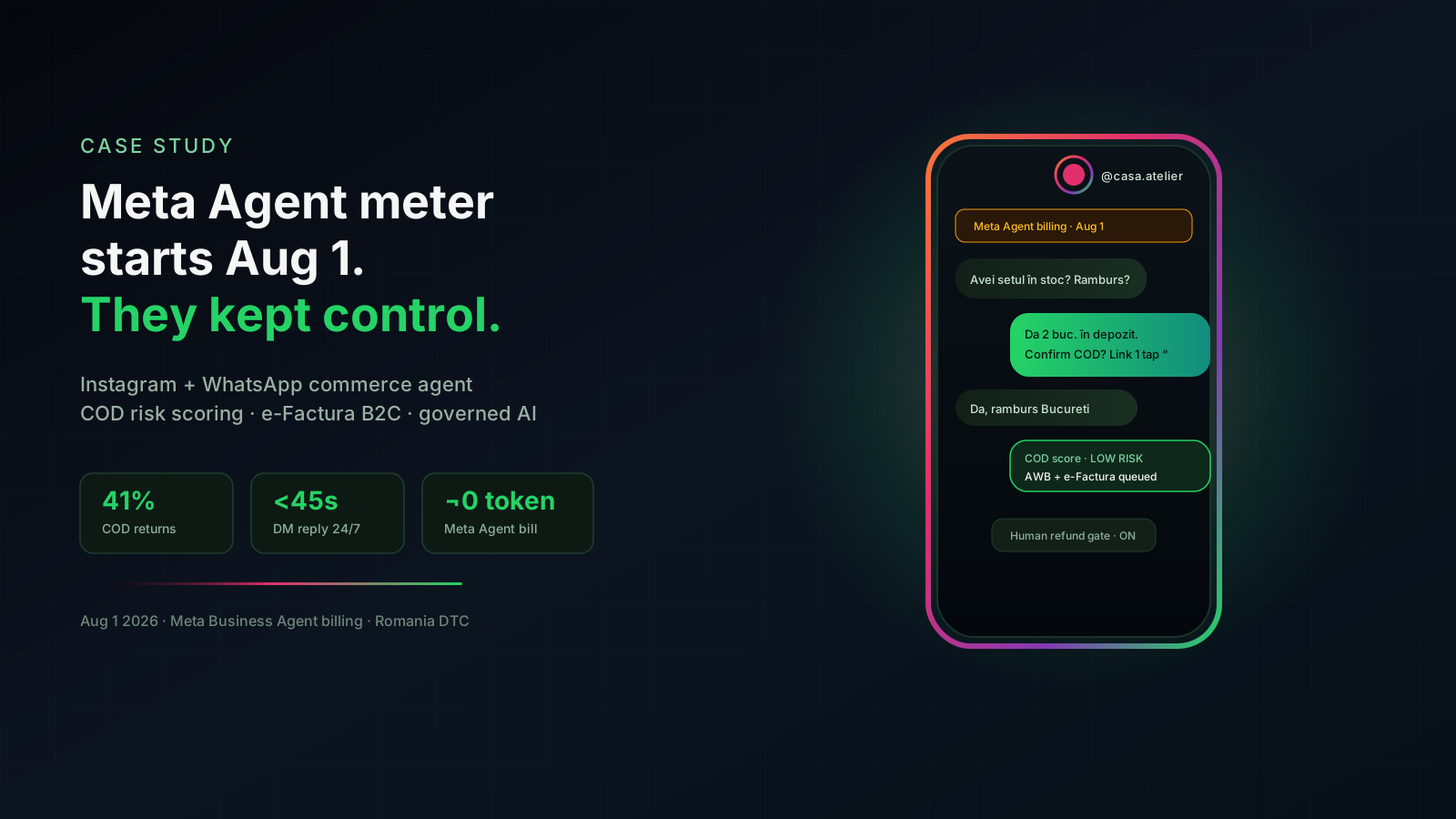
- COD / ramburs risk scorer: before any cash-on-delivery AWB prints, the agent checks address quality, prior refusals on the same phone/name, basket value, first-vs-returning buyer, and a short confirmation loop ('confirm you'll be home Thu 14–18') — high-risk orders are steered to card payment or held for human review; low-risk CODs flow straight to FanCourier
- One-tap checkout links inside the DM: Shopify draft order with the exact variant, shipping method, and payment choice — so the buyer never has to dig through the grid again after asking about the grey linen runner
- Shipping & 'unde e coletul?' autopilot: FanCourier / Sameday tracking pulled into the thread, proactive 'out for delivery' pings, and a structured exception path when the courier marks undeliverable — instead of the warehouse phone ringing at 11:00
- e-Factura B2C queue: every paid or delivered order drafts a structured invoice for the ops lead to submit to SPV ANAF the same day, with the buyer's data captured in-chat when they ask for a factură — 100% B2C compliant without a Friday-night XML scramble
- Refund & exchange gate: the agent collects photos, order ID, and reason, then parks anything over 200 RON (or anything tagged 'damaged / wrong item') in a human approval queue — no silent goodwill credits from a model that cannot see margin
- Cost & observability dashboard: per-channel conversation volume, COD acceptance rate, refusal rate, token/AI spend on the third-party stack, and a projected October service-message bill so finance is not surprised when Meta's free window on ordinary replies ends on 1 Oct 2026
The results after the first quarter of building — and the week before Aug 1
By late July 2026 the agent was handling 31,200 Instagram and WhatsApp conversations a month with a median reply under 45 seconds, around the clock. Eighty-one percent of routine threads — stock, shipping ETA, care instructions, 'do you wrap for gifting?' — closed without a human touch. The two community managers who used to live inside the Instagram inbox were redeployed onto creator seeding and the pop-up calendar, the work that actually moves brand, not the work of typing 'da, facem ramburs' for the four-hundredth time.
COD returns and refusals fell 41% versus the prior quarter. The risk scorer was not magic; it was mostly saying no — or saying 'card please' — to the patterns the warehouse already knew by smell. Average accepted COD basket rose slightly because the junk orders stopped printing labels. Outbound shipping cost per fulfilled order dropped enough that the founder stopped opening the FanCourier invoice with a flinch.
And the headline the finance lead cared about: on the morning of 1 August the Meta Business Agent meter read zero, because the brand had switched the Meta-native agent off before billing started and kept the governed third-party stack. Conversation AI cost sat on a flat monthly plan plus ordinary WhatsApp delivery — predictable on a quiet Tuesday and on the Tuesday a Reel hits 1.2 million views. The October 1 service-message cliff is already modelled in the dashboard; there is no surprise invoice waiting in Q4.
Secondary wins stacked up. Same-day e-Factura B2C coverage hit 100% of cash and card orders that requested an invoice. Cart-to-paid conversion from Instagram DM threads rose 29% once the one-tap Shopify draft link replaced 'here's our website, search for linen runner grey'. Customer complaints about unanswered weekend DMs fell off a cliff — the Trustpilot theme of 'nice products, ghost inbox' simply stopped appearing in the July export.
What we'd do differently
We left Meta Business Agent on in parallel for the first ten days of the pilot 'just to compare quality.' That was a mistake. Two agents answering the same Instagram Professional inbox created duplicate replies, double draft orders, and one very confused buyer who received two different shipping quotes two minutes apart. Kill the native agent the day the governed stack goes live — or put a hard channel split in writing. Parallel pilots on the same surface look like diligence; they feel like chaos to the customer.
We under-weighted the COD confirmation loop at first. A risk score without a 'reply DA to confirm you'll be home' step still printed too many polite ghosts. Adding the explicit confirmation cut another eight points off refusals in two weeks. If your market still runs on ramburs, the confirmation is not UX friction — it is the cheapest filter you will ever ship.
The line we'd underline for any Instagram-commerce brand staring at 1 August 2026: automate the conversation and the warehouse handshake, not the money decisions. A human still signs refunds, high-risk CODs, and anything that commits margin you cannot claw back. Meta's token meter made the cost of not owning that layer visible overnight. Owning it — with a flat AI plan, live stock, and a refund gate — is how you keep the viral day as a revenue event instead of an invoice surprise.
"Meta's free agent week felt like a gift. The August token meter felt like a trap on the exact days a Reel works. We kept the AI — we just stopped renting the judgment layer from a company that bills us more when we win."
— Founder & CEO, Instagram-first home brand