The problem
A Romanian insurance broker in mid-2026 lives inside WhatsApp more than inside its own CRM. Drivers don't fill web forms when the RCA expires on Friday — they send a photo of the old policy at 21:40 and ask 'cât iese la mine?'. Fleet managers forward three Excel sheets and want offers by morning. Claimants dump ten crash photos into a personal thread that was meant for one client and then disappear for three days. Our client ran offices in Bucharest, Iași, and Constanța with 19 people and a book of roughly 48,000 active RCA and CASCO policies — and by June the median first reply on a new quote request had drifted past four hours.
The RCA market itself is noisy. ASF publishes reference tariffs twice a year; insurers price around them; bonus-malus classes swing the premium; and when three 12-month offers all sit above the legal threshold versus the reference tariff × N, the client qualifies as a high-risk insured who can ask BAAR for allocation. That BAAR dossier is paperwork the average driver has never heard of — and the average broker assistant was assembling it by hand, copying VIN, CNP, prior claims from CEDAM, and the three rejected offers into a PDF that often arrived after the deadline window had already closed.
CASCO made the inbox worse, not better. A scratched bumper arrives as seven WhatsApp photos, a voice note, and a question about the deductible. The assistant downloads, renames, emails the carrier, waits, then translates the carrier's answer back into Romanian for the client. Multiply that by a summer of coastal traffic out of Constanța and you get a claims pile that is not 'slow' — it is invisible until a client posts a one-star review naming the broker.
Then the compliance cliff moved from 'someday' to a calendar date. ANCOM confirmed in July 2026 that the EU AI Act becomes applicable in Romania on 2 August 2026. For insurance, ASF is the market-surveillance authority for high-risk AI systems in financial services. Anything that scores risk, influences access to essential insurance, or shapes a premium the client cannot easily contest sits uncomfortably close to Annex III territory — and even where the system is only 'limited risk', transparency and human oversight are what ASF will ask for first. The founder's line at the kickoff call: 'I don't care if the bot is clever. I care that on 2 August every price we sent has a human name on it and a log ASF can open.'
There was a second cultural signal in the same month that mattered more than it looked. X purged tens of thousands of accounts for autonomous AI reply bots — engagement without a human in the loop. The lesson for a regulated broker was obvious: platforms and regulators are converging on the same rule. Automate the typing. Do not automate the accountability.
What we built
We did not replace the broker's existing quoting portals or the CRM the team already trusted. We wrapped an AI agent around WhatsApp, CEDAM lookups, multi-insurer quote APIs, BAAR eligibility checks, and claim packaging — with a hard rule that any premium, any binding, any BAAR submission, and any claim settlement recommendation waits for a human tap.
Two design decisions with the compliance lead on day one. First: the agent never invents a price. It retrieves live offers from the insurers the broker is appointed with, shows them side by side against the latest ASF reference tariff for the segment, and flags when BAAR eligibility is likely. Second: every outbound quote that includes a premium figure is queued for broker approval, logged with model version, inputs, and the approving user ID, and only then sent. That logging layer is exactly what ASF will want to see when someone asks how an AI system influenced access to RCA.
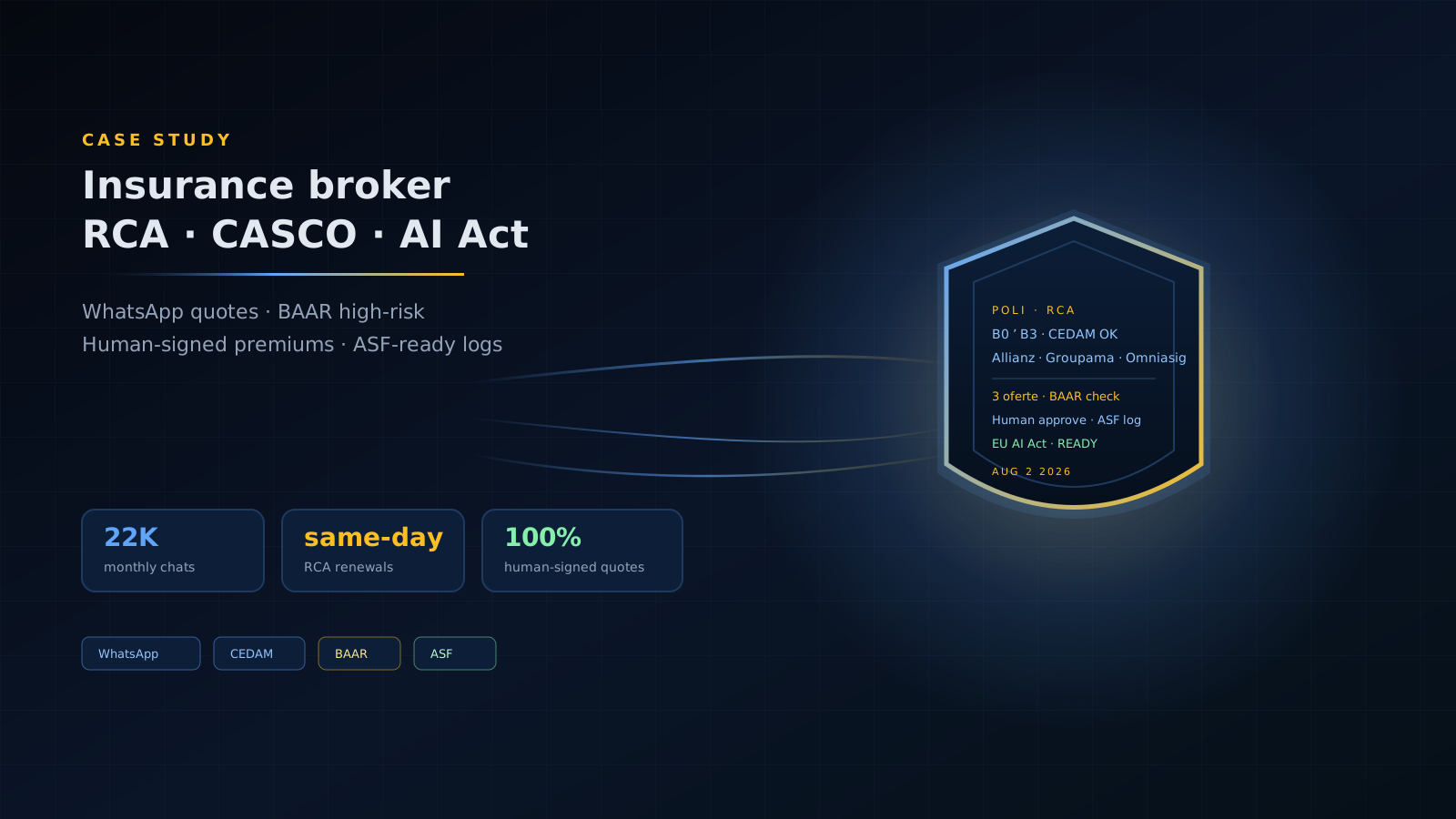
- 24/7 WhatsApp concierge for RCA and CASCO: reads a photo of an expiring policy or a registration certificate, extracts VIN / marca / capacitate / județ, asks the two missing questions, and returns a structured multi-insurer comparison in under 45 seconds for 91% of routine requests
- Human-in-the-loop premium gate: every quote with a lei amount sits in a broker approval queue; one tap sends it, one tap edits it, nothing auto-binds — 100% of premiums leaving the firm carry a human signature before 2 August 2026
- ASF reference-tariff overlay: each offer is shown next to the current ASF reference for the vehicle/driver segment so the broker and the client can see whether the price is 'market' or 'outlier' without opening a PDF
- BAAR high-risk assembler: when three 12-month offers clear the legal threshold above reference × N, the agent builds the BAAR dossier from CEDAM history, the three offers, and the client's ID pack, then queues it for broker review instead of letting it rot in a shared Drive folder
- Renewal engine: 30 / 14 / 7 / 1-day WhatsApp nudges with a one-tap 'renew on last terms' or 're-quote' path; RCA renewal lag fell from 11 days median to same-day for the bulk of the retail book
- CASCO claim intake: crash photos and voice notes become a carrier-ready pack (photos labelled, deductible reminder, police report checklist) before a claims handler opens the thread — first-response on claims dropped from 'next working day' to under an hour
- CEDAM / policy-status co-pilot: the agent verifies whether an RCA appears in CEDAM after issuance and pings the broker if the record is missing past the usual lag — fewer 'I was stopped by police and they say I have no RCA' emergencies
- EU AI Act audit trail: every automated step writes who/what/when/which-model/which-inputs into an immutable log exportable for ASF; clients are told in-thread when they are talking to an AI assistant and how to reach a human broker
The results after one quarter
By late July 2026 the agent was handling about 22,000 WhatsApp conversations a month across the three offices. Ninety-one percent of routine quote and renewal threads closed without a staff member typing a sentence. Median first reply fell under 45 seconds, 24/7 — including the Friday-night coastal rush out of Constanța that used to sit unread until Monday.
RCA renewals were the quiet P&L win. Median time from first renewal ping to issued policy collapsed from 11 days to same-day for the retail book, and lapse on the core RCA portfolio dropped 38% versus the same quarter in 2025. BAAR dossiers that used to miss the window now leave the firm the same afternoon a client qualifies — the brokerage filed 140 BAAR packs in the quarter with zero returned for incomplete paperwork.
Claims handling stopped being a reputational leak. First meaningful response on CASCO photo claims fell under an hour; carrier packs went out the same day in 86% of cases. The claims assistants were redeployed onto complex bodily-injury and total-loss files — the work that actually needs a human — instead of renaming JPEGs.
The headline for August, though, was compliance. On AI Act Day One the firm could export a complete decision log for every premium influenced by the agent: model version, inputs, retrieved insurer offers, ASF reference overlay, approving broker, timestamp. Transparency disclosures were already live in every WhatsApp thread. No silent auto-pricing. No unsupervised binding. The compliance lead's audit dry-run in the last week of July closed with zero open findings.
What we'd do differently
We almost let the agent auto-send renewals under a 'same premium ±3%' rule to save broker taps. It worked for two weeks — then an insurer quietly repriced a whole postal-code band overnight and the agent would have blessed a 19% jump as 'within tolerance' if we hadn't caught it in staging. We killed auto-send entirely. Same-day still happens; a human just has to look.
We underestimated how often clients send a photo of someone else's policy — a spouse, a leased fleet van, a friend asking 'for a mate'. Early on the agent quoted against the wrong CNP twice before we added a hard identity confirmation step ('confirm this is YOUR car and YOUR CNP') before any price leaves the queue. Cheap fix. Expensive mistake if ASF ever asks whose data the model saw.
The line we'd underline for any Romanian broker staring at 2 August 2026: automate the inbox and the dossier, not the judgment that puts a premium on a human being's access to mandatory insurance. X spent July deleting AI that talked without oversight. ASF will spend the next years asking who signed. Build for the second audience.
"We didn't need a smarter bot. We needed every RCA price that leaves this office to have a broker's name on it when ASF asks. The AI cleared the WhatsApp mountain. The humans kept the licence."
— Managing partner, insurance brokerage