The problem
For a Romanian language school, late August is not a soft landing into the school year — it is a flood. Parents who spent July on holiday suddenly remember that Cambridge Young Learners, B2 First, or the after-school English slot starts mid-September, and the window to secure a place is measured in days. Our client runs five campuses plus online cohorts: three in Bucharest, one in Cluj-Napoca, one in Iași. By mid-August 2026 the marketing team had done its job too well — Reels about open-doors week (the same pattern every big school was running, roughly 26 August–4 September) were sending parents straight into Instagram DMs and WhatsApp with the same five questions: Is there a place? What level is my child? How much? Can siblings share a discount? When is the placement test?
The first leak was speed. A parent who messages at 21:40 after putting kids to bed does not wait until Tuesday's front-desk shift. In the 2025 rush, the school answered fast during office hours and slowly after — and competitors with a night owl on the phone, or simply a faster 'yes we have a slot, here is the link,' quietly took the deposit. Instagram alone left hundreds of DMs on read past 20:00 in the peak week.
The second leak was the dossier. Enrollment is not a one-message sale. You need the learner's age, preferred campus, current level (or a placement-test booking), parent CNP for the contract and e-Factura B2C, emergency contact, medical notes for after-school, and a payment choice. Front-desk staff were chasing that pack across three WhatsApp threads, a Google Form that half the parents abandoned on mobile, and a printed sheet at the open-doors desk. Every incomplete file was a seat that looked 'reserved' on a whiteboard and was empty on day one.
The third leak was judgment dressed up as customer service. Parents asked for sibling discounts, for a 'guaranteed Cambridge pass,' for a move from one campus to another after the group was full, for a refund after three absences. The team meant well and sometimes over-promised in the chat — then operations had to walk it back. That is exactly the class of mistake an unsupervised bot will also make, which is why the brief from day one was: automate the pack and the calendar, never the commercial exception or the exam outcome.
Then the calendar added a cost cliff on top of the enrollment cliff. Meta's WhatsApp Business Platform changes for 2026 are not abstract for a school that lives in parent chat: Meta Business Agent token billing has been live since 1 August, and from 1 October 2026 every free-form service reply inside the 24-hour window — human or third-party AI — becomes a per-message charge at utility-equivalent rates, with utility templates inside that window billable too. A September rush run as a long free-form Q&A is a preview of an October bill the school cannot forecast. The founder's ask was blunt: fill the autumn groups, keep Art. 50 transparency clean, and redesign the conversation so October does not punish us for being helpful.
What we built
We did not replace the school's timetable or CRM — the academic team trusts their group planner, and the finance team already closes e-Factura B2C through their accountant. We wrapped an AI enrollment agent around Instagram, WhatsApp, and the existing calendar that owns the first reply, the placement-test booking, the structured dossier, and the deposit reminder — and escalates the second a parent asks for a custom price, a guarantee, a medical exception, or anything that sounds like a complaint.
Two hard rules with the academic director on day one. First: the agent discloses that it is AI in the opening sentence — EU AI Act Art. 50 transparency obligations have applied since 2 August 2026, and a language school talking to parents is not the place to bury that in a footer. Second: the agent never invents a discount, never quotes a pass rate, never moves a learner into a full group, and never confirms a refund. It can show published price lists, offer the sibling-discount request form to a human, and book a placement test. A person signs the commercial and pastoral decisions.
- 24/7 Instagram + WhatsApp enrollment concierge with Art. 50 disclosure on the first message: answers schedule, campus, age-band, and published-price questions in under 60 seconds in Romanian and English, and routes anything about money exceptions, complaints, or safeguarding straight to a coordinator
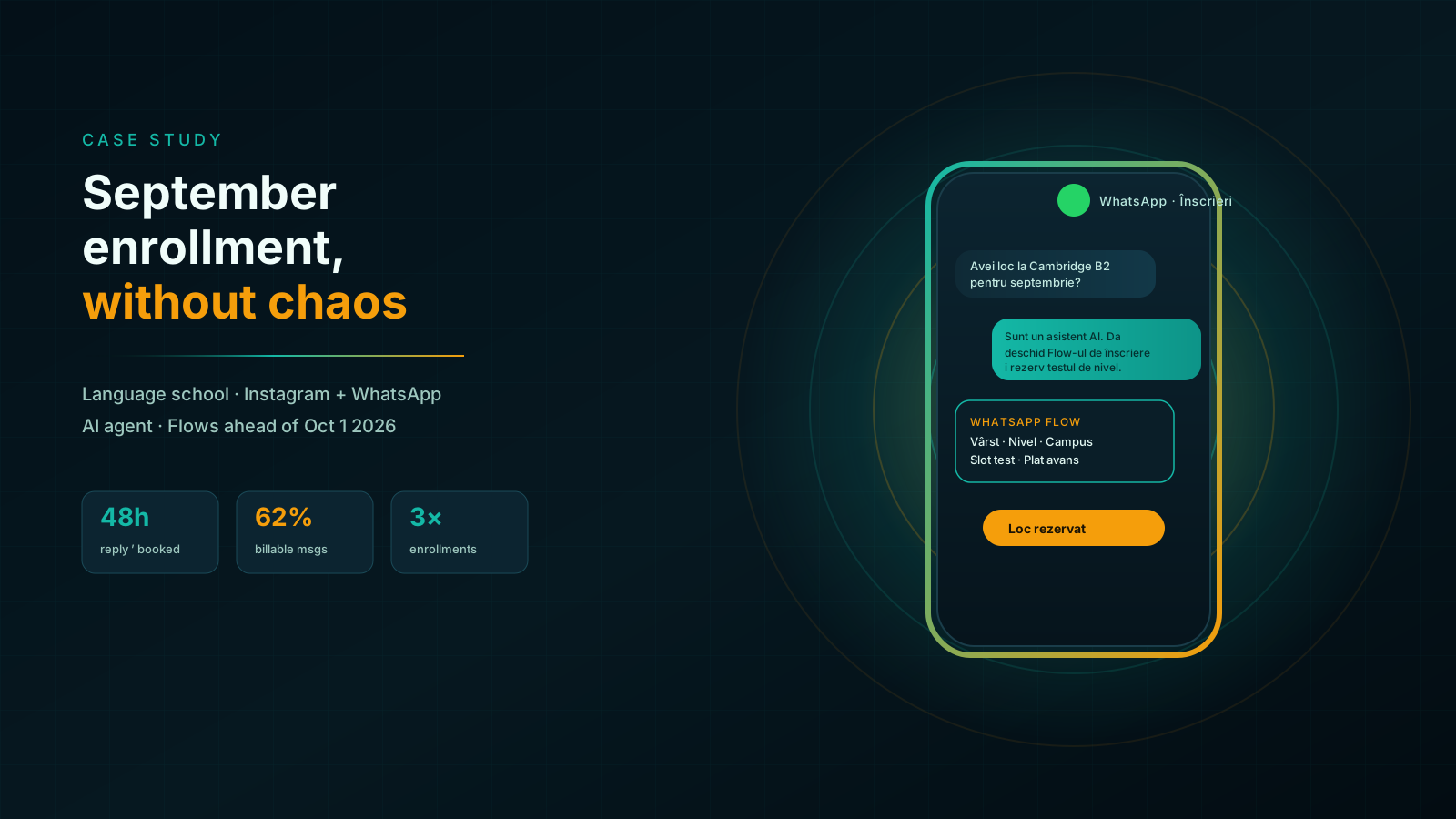
- Placement-test booking co-pilot: reads live capacity from the timetable, offers open slots by campus (or online), sends a calendar hold, and reminds the parent 24h and 2h before the test — 91% of tests in the rush booked without staff typing a time
- WhatsApp Flows enrollment pack: one structured Flow captures learner details, parent identity for the contract / e-Factura, campus preference, medical notes for after-school, and preferred payment — collapsing what used to be a 12–15 message free-form thread into a single interactive surface ahead of the 1 October service-message cliff
- Cost-aware conversation design: FAQ answers that used to take four chat bubbles are compressed; wherever a form can replace a ping-pong, Flows or a deep link wins; Click-to-WhatsApp ad entry points keep more of the early funnel inside the free 72-hour window where Meta still does not charge service messages
- Sibling & commercial exception queue: when a parent asks for a multi-child discount or a fee waiver, the agent collects the facts, drafts a one-screen brief, and parks it for a human — never auto-approves
- Deposit + e-Factura hand-off: once a place is confirmed, the agent sends the payment link, watches for settlement, and queues the B2C e-Factura pack for finance — so day-one lists match money in the account, not whiteboard optimism
- Waitlist and group-fill engine: when a level/campus is full, the agent offers the waitlist or the next campus / online cohort with an honest ETA, and pings the parent the minute a seat opens — instead of silence that sends them to the school across the street
- Open-doors week mode: for the late-August porchile-deschise window, the agent prioritizes walk-in follow-ups from QR codes at the desk, books same-week placement tests, and tags every lead with the campaign source so marketing can see which Reel actually filled groups
The results after the September rush
Across the four weeks that mattered — roughly the open-doors stretch into the first teaching week — the school confirmed three times as many autumn enrollments as the same window in 2025, on the same front-desk and academic-coordinator headcount. Median reply time on Instagram and WhatsApp fell under a minute around the clock; parents who used to leave a message and call a competitor the next morning were booking a placement test before they put the phone down.
Ninety-one percent of placement tests in the rush were booked by the agent without a human typing a slot. Incomplete enrollment files — the silent killer of 'reserved' seats — dropped sharply once the Flow replaced the multi-thread chase, and finance stopped starting October with a pile of CNP-less contracts.
The cost story is the one the founder watches for 1 October. By moving dossier capture into WhatsApp Flows and collapsing repetitive FAQ threads, projected billable free-form service messages for an equivalent conversation volume fell about 62% versus the 2025 chat pattern. That is not a promise that Meta's final per-market rates will be gentle — rates for service messages are due by 1 September 2026 — it is a structural cut in how many chargeable replies a single enrollment needs. The school also stayed off Meta's native Business Agent token meter for this workflow; a short custom agent on their own stack kept cost and tone under their control.
Compliance stayed boring, which is the point. Every first message named the AI. No automated message promised a Cambridge result. Every sibling discount and every refund request hit a human queue. e-Factura B2C packs for deposits went out through the existing finance path with a clean parent identity from the Flow. The academic director's line after week three: 'We finally sound as organised at 22:00 as we do at 10:00.'
What we'd do differently
We let the agent paraphrase published prices too freely in week one — rounding 'from' rates and bundling materials fees into a single number that sounded friendlier. Two parents screenshotted the chat when the contract showed a different total. We locked the agent to verbatim price-list cards and a 'materials listed separately' line, and any package that is not on the public sheet goes to a human. Friendly rounding is not a discount policy.
We underestimated how often grandparents and nannies message on behalf of parents. Early Flows assumed the WhatsApp number was the contracting parent; a handful of dossiers had the wrong CNP. We added a 'I am booking for someone else' branch and a confirmation step that names who signs the contract before payment.
The line we would underline for any language school or after-school heading into autumn 2026: automate the reply, the test slot, and the paperwork — never the promise. Art. 50 disclosure belongs in the first sentence, not the footer. WhatsApp Flows are not a nice-to-have UI polish; they are how you keep being helpful after 1 October without turning every parent question into an unforecastable invoice. And the agent is allowed to be wrong about which classroom has a projector. It is not allowed to be wrong about money, safeguarding, or whether a child 'will definitely pass Cambridge.'
"September used to mean three people living inside Instagram while groups filled by accident. Now the AI takes the night shift, Flows take the paperwork, and we only wake up for the decisions that actually need a human — discounts, safeguarding, and the odd parent who needs a real conversation. Walking into Meta's October pricing with a thinner message bill was the bonus we planned for on purpose."
— Academic Director & Co-Founder, language school network