The problem
A Romanian birou notarial in 2026 lives on WhatsApp whether it planned to or not. Clients do not open email for a procura for a minor's travel, a vânzare-cumpărare checklist, or a late-night question about whether the CI of a co-heir in Italy needs an apostille. They open Instagram after a Reel about 'acte necesare succesiune,' drop a comment, then bounce into DM — or they screenshot a half-remembered Facebook post and paste it into WhatsApp at 21:40. Our client ran three offices — Sector 1 Bucharest, an Ilfov corridor location that catches the peri-urban property wave, and a Brașov desk for mountain and diaspora files — with three public notaries, seven secretariat staff, and a shared phone that by August 2026 was the real front door of the practice.
The first leak was the checklist loop. A typical succesiune or property transfer needs ten to fourteen documents. The old workflow was: client asks what they need → receptionist types a paragraph → client sends three photos of the wrong side of a CI → receptionist asks again → client goes silent for nine days → shows up without the extras de carte funciară. By late summer the 'document-complete' backlog — files that had an appointment booked but could not be signed because something was missing — sat at six weeks. Waiting-room chairs filled with people who had driven in from Ploiești only to be told to come back Thursday.
The second leak was legal-adjacent improvisation. Receptionists are not notaries, but clients treat the first WhatsApp reply as advice. 'Can my brother sign with a procura from Spain?' / 'Do we still need the city-hall sesizare after OUG 7/2026?' / 'How much will the inheritance tax be?' A well-meaning reply that drifts one sentence too far is not just a compliance risk under the notarial profession's rules — it is also exactly the kind of high-stakes output the EU AI Act's Art. 50 transparency rules and the Chamber's ethics expectations do not want floating around unsupervised chat logs.
Then the calendar itself became the third leak. Instagram Reels about 'divorț pe cale notarială' and 'procură rapidă București' were converting, but 41% of after-hours DMs sat unread past 20:00, and the ones that got answered often booked the wrong office or the wrong notary for the deed type. Brașov slots filled with Bucharest CI legalisations that could have been done in Sector 1; succession files that needed the Ilfov notary's diary landed on the wrong Tuesday.
Hovering over all of it was Meta's October 1 2026 cliff — less than a month away when we started. From that date WhatsApp service messages (every free-form reply from a human or a third-party AI inside the 24-hour window) and utility templates sent inside that window become billable. Romania moved to a standalone rate card earlier in 2026 with higher utility and authentication prices, so every chatty 'still waiting on your extras CF' was about to have a price. Meta's published allowance is 1,000 free service messages per business phone number per month; unused units do not roll over. A payment method must sit on the WABA by 30 September or delivery simply stops on day one. The managing notary's brief was blunt: 'we will not discover our October bill on 5 October, and we will not let a bot practise law.'
What we built
We did not replace the practice's case file software or pretend an agent could draft an încheiere. We wrapped an intake-and-comms layer around WhatsApp, Instagram, and the shared calendar that owns the conversation, the document chase, and the booking — and hard-stops the moment a question requires a notary's judgment. The bot collects; the notary authenticates.
Two rules locked on day one with all three notaries. First: Art. 50 transparency in the first sentence of every automated thread — the client always knows they are talking to an AI assistant of the birou, not a notary. Second: the AI never quotes a binding fee for a complex deed, never opines on inheritance shares, never confirms that a foreign procura is 'enough,' and never tells a client they can skip the 2026 city-hall cerere/sesizare step for succesiune. Those go to a human with a structured summary. Both rules are also how you keep an agentic system from becoming an expensive liability the week Meta starts metering every reply.
- 24/7 Instagram + WhatsApp concierge with Art. 50 disclosure on first reply: handles hours, office addresses, parking, which deeds are same-day vs. multi-visit, and routes comment-to-DM from Reels into the same state machine — median reply under 45 seconds
- WhatsApp Flows for the high-volume checklists (succesiune, vânzare-cumpărare, procura, declarații, divorț pe cale notarială): structured forms replace five free-form back-and-forths with one Flow submission, which is the single biggest lever against the Oct 1 service-message bill and Romania's higher standalone rates
- OCR + completeness gate: clients upload CI, certificat de deces, extras CF, certificate de naștere/căsătorie; the agent checks readability, expiry, name consistency, and missing sides before a slot is confirmed — incomplete packs stay in 'document chase' instead of blocking a notary's morning
- Succesiune 2026 pathing: the Flow explains the city-hall-first cerere / sesizare sequence under the 2026 administrative changes, collects what the office needs next, and never tells a client the Chamber appointment is optional — humans handle edge cases (diaspora heirs, contested wills, missing death certificate)
- Multi-office scheduling co-pilot: books against the right notary, the right office, and the right deed duration, with T−48h / T−24h utility-template reminders and a one-tap reschedule — wrong-office bookings dropped sharply in the first month
- Human escalation pack: any question about tax, shares, validity of foreign documents, or 'is this enough to sign tomorrow?' jumps to the on-duty notary or senior secretary with the Flow payload, OCR flags, and chat transcript attached — no improvisation in the channel
- Message-budget dashboard: live counters per WABA number against the 1,000 free service messages, projected October spend at Romania utility-equivalent rates, and alerts at 70% / 90% of the free tier so the team can shift more traffic into Flows before they start paying
- Payment-method & delivery guard: WABA billing method confirmed before 30 September; dry-run of utility templates for appointment and document-missing notices so Oct 1 does not become a silent outage day
The results after six weeks
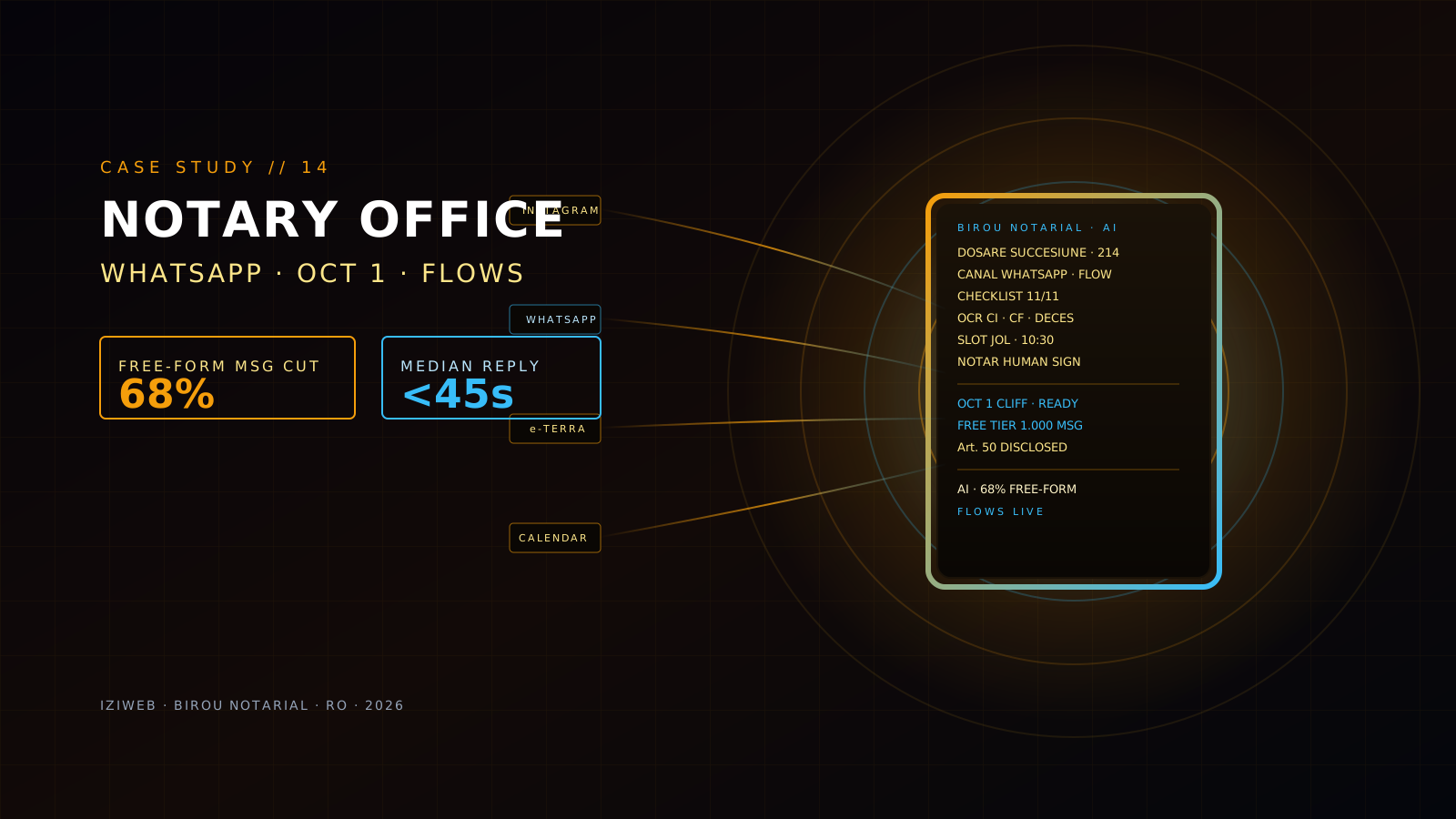
By early September the stack was live across all three numbers. Free-form outbound replies — the category that becomes billable on 1 October — were already 68% below the August baseline, mostly because checklist conversations that used to burn eight to twelve service messages now close inside a Flow. On the projected October mix, all three numbers sit comfortably inside or just above the 1,000 free service messages, with a blended WhatsApp bill modelled under €180 even after Romania's higher standalone utility rates. That is the difference between 'messaging is free so type paragraphs' and 'messaging is a line item so design the conversation.'
Speed stopped being the weekend problem. Median reply across WhatsApp and Instagram fell under 45 seconds around the clock, and the after-hours unread pile that used to greet the secretariat on Monday morning essentially disappeared. Comment-to-DM from Reels about procura and same-day declarații converted into booked Sector 1 slots without a human typing the parking instructions for the hundredth time.
The document backlog was the operational win the notaries felt in their diaries. Average time from first contact to a document-complete file ready for authentication fell from six weeks to under four days for the standard packs. Waiting-room 'please come back with the extras CF' moments dropped with them. Secretariat hours shifted from re-typing checklists to preparing the actual încheiere packs the notaries needed signed.
We deliberately did not switch the FAQ layer to Meta Business Agent. At roughly 4–5 US cents per message in tokens it is the wrong economics for high-volume 'what documents do I need?' traffic, and it would still leave the practice paying for delivery on top of every third-party model call if you stay on a custom stack — the cheaper move was fewer free-form messages, not a more expensive brain on every ping.
What we'd do differently
We under-estimated how often a third party — a real-estate agent, a bank officer, a relative abroad — opens the WhatsApp thread on behalf of the client. Early Flows assumed the person chatting was the signatory. Two near-misses later we added a hard gate: the agent will not treat a third-party booker as the party to the deed, will not accept a CI photo 'for my client' as identity of the chatter, and will only collect documents with an explicit mapping to each heir or seller. If you automate notarial intake, identity of who is in the chat is not a UX detail.
We also shipped one Flow that asked an optional free-text field for 'anything else we should know?' — and clients used it to paste full legal narratives the model then tried to summarise into the escalation pack. Summaries drifted. We removed the free-text catch-all from production Flows and replaced it with a single button: 'I need to talk to the notary.' Structured beats expressive when the output sits next to a seal.
The line we would underline for any birou notarial staring at 1 October 2026: automate intake, checklists, OCR, and reminders — never advice, never a binding quote on a complex deed, never a promise that a foreign document is sufficient. Disclose the AI in the first sentence. Put a payment method on the WABA before 30 September. Count every free-form reply against the 1,000 free tier. Prefer WhatsApp Flows over clever paragraphs. A notary's stamp is not a feature an agent gets to borrow.
"October 1 was going to turn every 'ce acte îmi trebuie?' into a cost centre. The AI does not replace the notary — it stops us burning the free tier on checklists and keeps the legal judgment where it belongs."
— Managing public notary, multi-office practice